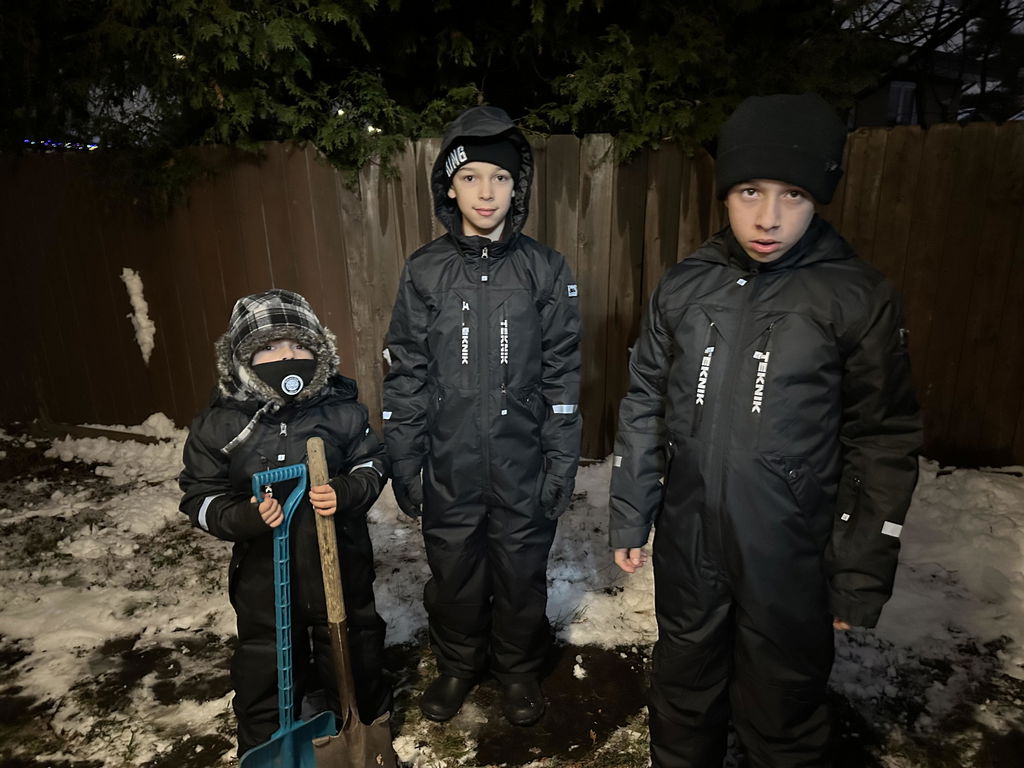
Quick answer: Most preschool and school kids in snowy places need snow pants for recess, plus either a snowsuit jacket or a warm winter coat. Calgary's Capitol Hill School, for example, asks families for a winter coat and "Snow Pants: To keep legs warm and dry during outdoor play." A two-piece snowsuit covers both jobs in one set.
Once kids start daycare, preschool or kindergarten, winter outerwear stops being about the stroller walk and starts being about recess: kneeling in snow, sliding down hills and sitting on cold benches, twice a day, every day. That changes the question from "Which snowsuit?" to "Do we need a snowsuit at all, or will a good winter coat do?"
This guide answers that question. If you've already decided on a snowsuit and are choosing between styles, our one-piece vs. two-piece snowsuit comparison goes deeper on that choice.
In this guide:
- The real difference between a winter coat, a two-piece snowsuit and a one-piece
- What schools and daycares ask families to send
- Whether a coat alone works for recess
- Which setup kids can put on by themselves
- How cold, wet or mild winters change the answer
- Layering, fit and sizing for school
- A decision table and when you need both
This article is for general information. It is not medical advice. Talk to your health-care provider if you have questions about your child and cold weather.
What Is the Difference Between a Winter Coat and a Snowsuit?
A winter coat is an insulated jacket on its own. A snowsuit adds insulated, water-resistant snow pants, either as a matching two-piece set (jacket plus snow pants) or as a one-piece that covers the whole body. The key difference is the legs: a coat keeps the upper body warm, while a snowsuit keeps the whole body warm and dry in snow.
In practice, parents choose among three setups:
- Winter coat plus separate snow pants. A parka or puffer that works on its own, paired with snow pants or snow bibs on snowy days, such as the Deux par Deux Play Snow Pants Navy Blue.
- Two-piece snowsuit. A jacket and snow pants designed and sold together, usually with matching features such as a snow skirt, suspenders and ankle gaiters.
- One-piece snowsuit. A single suit from hood to ankles, with no gap at the waist.
| Feature | Coat + snow pants | Two-piece snowsuit | One-piece snowsuit |
|---|---|---|---|
| Wear the top alone | Yes, made for it | Yes, the jacket works alone | No |
| Gap at the waist | Possible if pants sit low | Covered by snow skirt and bib pants on many styles | None |
| Easy to dress alone | Moderate | Moderate | Easier for some younger kids, harder for bathroom breaks |
| Bathroom breaks | Easy | Easy | Slower |
| Flexibility on mild days | High | High | Low |
| Typical age | School-age | Preschool to school-age | Toddler to early preschool |
What Do Schools and Daycares Actually Ask For?
Schools where kids play in snow at recess often ask for both a coat and snow pants. Capitol Hill School in Calgary is a clear example. Its cold weather page asks families to send a "Winter Coat: Warm, insulated, and ideally waterproof" and "Snow Pants: To keep legs warm and dry during outdoor play," along with insulated, waterproof boots and hats, gloves or mittens.
The same page explains why it matters: "students will continue to go outside for recess and other activities unless the temperature, including wind chill, drops below -20°C, as per Calgary Board of Education policy." In other words, kids are outside in real winter weather well below freezing. The school also asks parents to "label all clothing with your child's name to avoid items being misplaced."
Lists like this vary by school board, region and daycare, so check yours. Two things to keep in mind:
- "Winter coat" doesn't have to mean a separate coat. A two-piece snowsuit jacket is a winter coat. If the list asks for a coat and snow pants, a two-piece snowsuit set covers both.
- Swap the scarf for a neck warmer. Some school lists mention scarves. The Canadian Paediatric Society's Caring for Kids winter guidance advises: "Use a neck warmer instead of a scarf, and mitten clips instead of a string to prevent choking." See our kids' winter accessories for neck warmers and mittens, and our comparison of neck warmers, scarves and balaclavas for kids to choose the right one for recess.
Does a Winter Coat Alone Work for Recess?
Only when there's little or no snow on the ground. A warm coat keeps the upper body comfortable, but as soon as kids kneel, sit or slide in snow, regular pants soak through. Wet legs then make the whole child cold for the rest of the day.
The American Academy of Pediatrics' HealthyChildren.org winter guidance advises: "Make sure children change out of any wet clothes right away." That's hard to do at school, where kids may have one set of clothes until home time. Snow pants keep regular clothes dry underneath, so kids come back to class comfortable.
A coat alone can work when:
- The ground is bare or frozen, with no snow to play in
- Your child only walks to and from the car or bus
- Recess is short and kids stay on paved areas
- It's a cold but dry day in the shoulder season
For wet, rainy days without snow, a rain suit is often a better fit than either. Our guide to rain suits vs. snowsuits for slush and shoulder season covers that in-between weather.
Coat and Snow Pants, Two-Piece or One-Piece: Which Is Better for School?
For most school-age kids, a two-piece snowsuit or a coat with matching snow pants is the most practical choice. One-pieces suit toddlers and younger preschoolers who don't yet manage bathroom breaks alone in outerwear, or who spend most of their outdoor time rolling in snow.
Coat with separate snow pants
This setup gives you the most flexibility. The coat goes on every day, and the snow pants stay at school or go on only when there's snow. It's also handy if your child grows out of one piece before the other: you replace only what's too small. The trade-off is fit at the waist. Choose snow pants or snow bibs that come up high enough to overlap the coat, and a coat long enough to cover the waistband when your child bends over.
Two-piece snowsuit
A two-piece set is designed to work together. On many styles, a snow skirt inside the jacket and bib-style pants with suspenders close the gap at the waist. For example, Deux par Deux lists a snow skirt on its PLAY two-piece jacket and "removable adjustable suspenders" on the matching pants. The jacket can be worn on its own on milder days, so for many families it replaces a separate winter coat entirely.
One-piece snowsuit
A one-piece has no waist gap at all and only one zipper to manage. It's warm and simple for toddlers and younger preschoolers. For older kids it's harder to take off for bathroom breaks, and there's no jacket to wear on its own. Our preschool and elementary snowsuit guide covers which snowsuit features matter most at each school stage.

Can Your Child Dress Themselves?
Independence matters more at school than at home. In many classrooms, teachers help a whole group get ready for recess at once, so outerwear your child can manage alone saves time and frustration. Before you buy, picture your child getting dressed by the classroom door in under five minutes.
Here's what tends to help:
- Big zipper pulls. Large pulls are easier for mittened or small fingers. Practice zipping at home, starting the zipper for younger kids.
- Velcro cuffs and closures. Hook-and-loop tabs are easier than snaps or buttons. The CPS also recommends removing drawstrings from younger children's clothing that "could catch on climbing or play equipment" and using "Velcro or other snaps instead."
- Suspenders that stay attached. Bib-style snow pants are easier to pull up if the suspenders are already adjusted to your child's size. Set them once at home.
- A dressing order. Teach a simple sequence: snow pants, boots, coat, neck warmer, hat, hood, mittens. Snow pants go over the top of boots to keep snow out.
- Name labels everywhere. Label the coat, snow pants, hat and each mitten.
Practice is the real secret. A few "recess drills" at home in October make the first snowy week much smoother for your child and their teacher.
How Does Your Local Weather Change the Answer?
Snow cover and wind chill matter more than the name of your city. If kids play in snow most winter days, they need snow pants. If winters are mostly wet and mild, a waterproof layer matters more than heavy insulation. If it's cold and dry with little snow, a warm coat may cover most days.
Use these official thresholds to understand the cold your child will face:
- School recess limits. The Calgary Board of Education keeps students indoors when the temperature, including wind chill, drops below -20°C, according to Capitol Hill School's page. Policies vary, so ask your school.
- Pediatric guidance. The CPS says to consider keeping children indoors "whenever the temperature or the wind chill is reported to be -27°C (-16°F) or lower." The AAP says "playing outside in temperatures or wind chills below -15° Fahrenheit should be avoided."
- Wind chill risk. Environment and Climate Change Canada's wind chill guidance warns that at -28 to -39, "any exposed skin can freeze in 10 to 30 minutes."
So at a school with a policy like Calgary's, kids still go outside at recess when the wind chill is between -10°C and -20°C. In snowy regions, that's snowsuit weather. On rainy, slushy days near 0°C, a waterproof shell matters more than warmth; see how shells differ in our guide to snowsuits for prairie cold vs. coastal rain.
What Should Kids Wear Under a Coat or Snowsuit?
Thin layers, not one thick sweater. The AAP says "Wearing several thin layers will help keep kids warm and dry," and the CPS advises children to "Dress in layers of clothing that can be put on and taken off easily."
That matters at school, where kids move between a warm classroom and a cold playground several times a day. A simple setup:
- Base layer: a fitted long-sleeve top and leggings, from kids' base layers
- Middle layer: their regular school clothes, such as a sweatshirt or fleece
- Outer layer: the coat or snowsuit, plus boots, a hat, mittens and a neck warmer
Avoid over-bundling. The CPS notes that "If your child is dressed too warm, they could sweat and feel colder when they stop playing." For more detail, see our no-sweat layering formula for under a snowsuit and our 3-layer guide for changing weather.
How Should a Winter Coat or Snowsuit Fit for School?
It should fit over normal school clothes, allow full movement, and cover wrists and ankles when your child reaches and crouches. Check these points before removing the tags:
- Reach test. Arms straight up: the sleeves should still cover the wrists.
- Squat test. Crouch down: the coat or jacket should still overlap the snow pants at the back.
- Leg length. Snow pants should cover the top of the boots while your child is sitting.
- Hood check. The hood should fit over a hat without covering the eyes.
Be careful with sizing up. Some brands already build in extra room. Deux par Deux says its PLAY snowsuits fit generously and advises parents not to size up, and describes its DISCOVER line as running generous as well. Both lines list grow-with-me features: sleeves that extend 4 cm (1.5"), plus an adjustable hem. For a step-by-step method, see our snowsuit sizing guide for babies, toddlers and big kids.
Winter Coat or Snowsuit: Which One Fits Your Child's Day?
Use this table to match the outerwear to your child's routine. Most families land on a two-piece snowsuit or a coat with snow pants.
| Your situation | Recommended setup | Why |
|---|---|---|
| Daycare or preschool, ages 2 to 4, snowy winters | One-piece or two-piece snowsuit | Full coverage for snow play; one-piece is simplest for younger kids |
| Kindergarten to grade 6, snowy winters, outdoor recess daily | Two-piece snowsuit or coat + snow pants | Matches typical school lists; jacket can be worn alone |
| Bus stop or long walk to school in deep cold | Warm coat + snow pants, neck warmer, hat that covers ears | More covered skin for longer waits |
| Mostly wet, slushy winters near 0°C | Waterproof shell or rain suit + warm layers | Staying dry matters more than heavy insulation |
| Cold but little snow; kids stay on pavement | Winter coat alone, snow pants on hand | Legs stay dry without snow contact |
| Ski hill, sledding or outdoor rink on weekends | Snowsuit | Built for long periods in snow |

When Do You Need Both a Winter Coat and a Snowsuit?
You need both when your child's days split between snow play and places where a full snowsuit is too much. Common examples:
- A one-piece for daycare, a coat for everything else. A one-piece suits the daycare yard, but it's a lot for a quick store run or a family dinner. A separate coat fills the gap.
- Snow pants stay at school. Some families leave snow pants and spare mittens at school all winter and send their child in a coat each day.
- A dressier coat for events. A school snowsuit takes a beating. Many parents keep a separate coat for church, holidays and visits.
- Two sets for drying time. If your child plays hard every day, a coat and a snowsuit jacket let one dry while the other is worn.
If you're buying just one outfit, a two-piece snowsuit is usually the most flexible single purchase, since the jacket doubles as a winter coat.
How Do Coat and Snowsuit Features Compare at Jenni Kidz?
Here are examples from Deux par Deux, with every detail taken from the brand's product listings. One useful difference shows up in the specs: Deux par Deux lists a 5,000 mm polyurethane coating on its Winter Jacket Black, and 10,000 mm on the PLAY and DISCOVER snowsuits below. If the coat will see a lot of snow play, compare that number before you decide.
- Winter coat: The Winter Jacket Black has synthetic down insulation, a fleece lining, a wind flap with chin guard and a removable faux-fur hood trim. Deux par Deux lists a -30°C (-22°F) rating. It comes in sizes 3 to 14.
- Winter coat with shimmer: The Winter Puffy Jacket White Glitter has synthetic down rated to -30°C (-22°F) by Deux par Deux, elastic cuffs and hem, and an inside pocket with a name label.
- Two-piece snowsuit for school-age kids: The Two Piece Play Snowsuit Mint Green includes a jacket with snow skirt and pants with removable suspenders and Cordura® at the knees, seat and hems. Deux par Deux lists a polar fleece neckwarmer as included. Sizes 3 to 12.
- Two-piece snowsuit for preschoolers: The Two Piece Discover Snowsuit Blue Bear Print pairs a bear-print jacket with dark gray bib snow pants with detachable suspenders. Sizes 3 to 8.
- One-piece snowsuit: The Kids One Piece Play Snowsuit Gray And Blue Dinosaur Print has fleece lining in the body and hood, a -30°C (-22°F) rating listed by the brand and an included polar fleece neckwarmer. Sizes 2 to 9.
Browse more options in girls' coats and jackets, boys' coats and jackets, two-piece snowsuits, one-piece snowsuits and all kids' snowsuits and snow pants.
Frequently Asked Questions
Does my child need a snowsuit or a winter coat for school?
If there's snow on the ground and outdoor recess, most kids need snow pants plus a warm jacket. A two-piece snowsuit covers both. A winter coat alone works on days with little or no snow.
Do schools require snow pants?
Some do. Capitol Hill School in Calgary lists "Snow Pants: To keep legs warm and dry during outdoor play" on its cold weather page. Policies vary, so check your school's or daycare's list.
Is a two-piece snowsuit the same as a jacket and snow pants?
Mostly, yes. A two-piece snowsuit is a jacket and snow pants designed to work together, often with a snow skirt and bib-style pants to close the gap at the waist. The jacket can usually be worn alone.
Is a one-piece snowsuit good for school?
For toddlers and younger preschoolers, a one-piece is warm and simple. For school-age kids, a two-piece is usually easier because they can manage bathroom breaks and wear the jacket on its own.
At what temperature do kids stay inside for recess?
It depends on the school board. The Calgary Board of Education keeps students indoors below -20°C including wind chill. The CPS suggests considering keeping children indoors at -27°C (-16°F) or lower.
Should I size up my child's winter coat or snowsuit?
Check the brand's guidance first. Deux par Deux says its PLAY snowsuits fit generously and advises parents not to size up, and its PLAY and DISCOVER snowsuits list extendable sleeves and adjustable hems for growth.
Can kids wear a scarf to school in winter?
A neck warmer is the better choice for school. The Canadian Paediatric Society advises parents to "Use a neck warmer instead of a scarf, and mitten clips instead of a string to prevent choking."
Bottom Line
For most preschool and school kids in snowy places, the answer is snow pants plus a warm jacket, and a two-piece snowsuit delivers both in one matching set. A separate winter coat earns its place for snow-free days, errands and events, while a one-piece suits younger kids at daycare. Check your school's list, choose outerwear your child can put on alone, dress in thin layers underneath and label everything.
Sources
- Capitol Hill School, Calgary Board of Education: Cold Weather (last modified 2025-11-28)
- Canadian Paediatric Society, Caring for Kids: Winter safety
- American Academy of Pediatrics, HealthyChildren.org: Playing Outside in Winter
- Environment and Climate Change Canada, Canada.ca: Wind chill and the Wind Chill Index (date modified 2025-12-16)