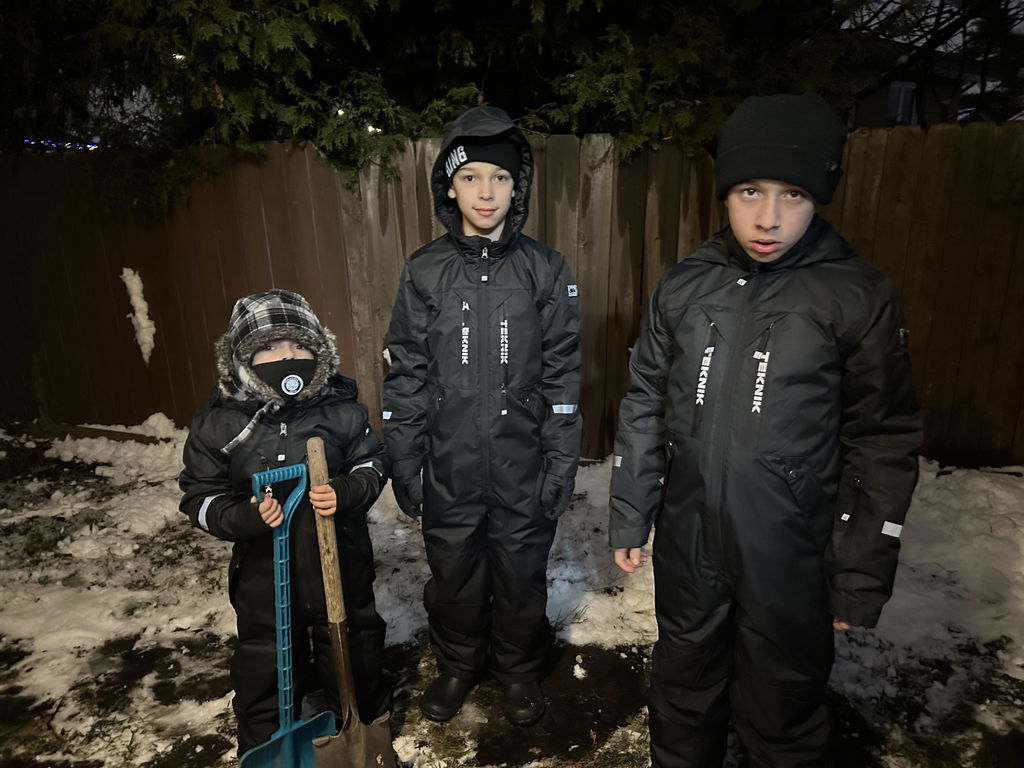
Quick answer: One piece vs two piece snowsuit? A one-piece usually suits babies and toddlers because there is no waist gap for snow to slip into. A two-piece is usually more practical for school-age kids who handle bathroom trips, recess and changing temperatures. Warmth depends more on insulation, fit and layers than on format.
Whether you call it a snowsuit or a snow suit, both formats can keep a child warm when the fit and layers are right. What changes is how each one fits your child's age, your daily routine and the kind of snow play your family does.
This guide is the format decision: one-piece or two-piece, by age, routine, activity and climate. If you already know the format and want help reading a specific brand's specs, our Deux par Deux snowsuit guide covers lines, ratings and features in detail.
Shop the guide: To see both formats from the same line, compare the Deux par Deux PLAY one-piece snowsuit in sage green and gray with the PLAY two-piece snowsuit in mint green, both listed in sizes 2 to 14, or browse every brand in our kids' snowsuits.
This guide is general information, not medical advice. Ask your pediatrician or family doctor if you have concerns about your child and cold weather.
What Is the Difference Between a One-Piece and a Two-Piece Snowsuit?
A one-piece snowsuit is a single suit that runs from the hood to the ankles with one main zipper, while a two-piece snowsuit is a separate jacket and snow pants sold as a set. That single difference drives almost everything else in this guide.
In a one-piece, the torso is continuous, so there is no waistband for snow to slip under when your child sits or rolls. Dressing means stepping in and zipping up; undressing means taking the whole suit off, which matters for bathroom trips.
In a two-piece, the jacket and pants work independently. The jacket can be worn on its own on milder days, and the pants can come off without removing the jacket. Many two-piece sets use bib-style snow pants (sometimes called snow overalls) that rise above the waist and are held up with suspenders. A bib reduces the waist gap because the jacket overlaps the pants instead of meeting them at a single seam.
For example, on its PLAY two-piece set at Jenni Kidz, Deux par Deux lists bib snow pants with removable adjustable suspenders and an elastic waist, plus a snow skirt inside the jacket. On its PLAY one-piece, Deux par Deux lists an adjustable interior waist instead, since there is no separate waistband.
One Piece vs Two Piece Snowsuit: Side-by-Side Comparison
The table compares the formats in general. Warmth is left out on purpose; the next section explains why.
| Feature | One-piece snowsuit | Two-piece snowsuit |
|---|---|---|
| Snow at the waist | No waist seam, so no gap when kids sit or roll | Depends on jacket length, bib height and a snow skirt |
| Dressing | One zipper; easy for an adult to put on a baby | Two pieces; easier for older kids to manage alone |
| Bathroom trips | Whole suit has to come down | Pants come off; jacket can stay on or off |
| Indoor transitions | All or nothing | Jacket can be worn alone on milder days |
| Sizing | One size must fit torso, arms and legs | Set is sold in one size, but each piece is checked separately at try-on |
| Growth room | Depends on listed grow features | Depends on listed grow features |
| Usually suits | Babies, toddlers, deep-snow play | Preschool and school-age kids, recess, ski days |
Is a One-Piece Snowsuit Warmer Than a Two-Piece?
Not automatically. A one-piece removes the waist gap, but how warm a snowsuit feels depends mostly on its insulation, its shell, how well it fits and what your child wears underneath.
Think of a snowsuit as a system with a few weak spots: the waist, the wrists, the ankles and the neck. A one-piece closes the first weak spot by design. A two-piece closes it with overlap, such as a jacket that covers the top of bib pants and a snow skirt that grips at the hips. The wrists, ankles and neck need attention in both formats, which is why cuffs, ankle snow guards and a neckwarmer matter as much as the format itself.
The clearest way to see this is to compare the same line in both formats. At Jenni Kidz, Deux par Deux lists the same numbers for its PLAY one-piece in dinosaur print and PLAY two-piece with checkerboard pants:
- A rating of -30°C (-22°F)
- Polyester fill of 57 g in the hood and 170 g in the body, sleeves and legs
- A polyurethane-coated shell rated 10,000 mm, with breathability listed at 5,000 g/m²/24h
- 500-denier Cordura® at the knees, seat and hems
Now compare a different line. For its Baby Original one-piece, Deux par Deux lists 255 g of fill in the body and a shell coated to 5,000 mm. The format is the same as the PLAY one-piece, but the listed specs are different. In other words, the line and the build tell you more about warmth and wet-weather performance than the words "one-piece" or "two-piece" do.
Fit matters just as much: too big leaves air pockets and gaps at the cuffs; too small compresses insulation and pulls at the shoulders and crotch. Layers matter too: the American Academy of Pediatrics notes that "several thin layers will keep them dry and warm."

Which Format Fits Each Age?
Age is the most useful starting point, because it predicts who does the dressing and how often bathroom trips happen.
Is a one-piece better for babies?
For most babies, yes. Babies are dressed by an adult, they are often carried or pushed in a stroller, and they cannot tell you when snow has slipped under a jacket. A one-piece keeps the whole body covered in one step.
The American Academy of Pediatrics (HealthyChildren.org) advises dressing older babies and young children in "one more layer of clothing than an adult would wear in the same conditions," and reminds parents to add warm boots, mittens and a hat. A one-piece with attached or removable extras makes that easier. On its Baby Original one-piece, for example, Deux par Deux lists removable fleece-lined mittens and booties, stretch cuffs, adjustable rubber stirrups and ankle snow gaiters, in sizes 6 months to 30 months/2T. Browse current options in baby girls' snowsuits and baby boys' snowsuits.
Packing for a winter trip with an infant? Our guide to infant bunting vs one-piece snowsuits for winter travel compares the two baby options.
Which format is better for toddlers?
For young toddlers, a one-piece is still usually the easier choice. Toddlers crawl, sit and roll in snow constantly, and a one-piece keeps snow out of the back. On the Kids One Piece Play Snowsuit Blue With Black Stripes, for example, Deux par Deux lists an adjustable interior waist, inner stretch cuffs and an ankle snow guard, in sizes 2 to 14. The trade-off appears with potty training.
Which format is easier during potty training?
A two-piece is usually easier. When a child needs the bathroom quickly, pulling down bib pants is faster than unzipping and stepping out of an entire suit. If your toddler is mid-training and spends most outdoor time at home with you, a one-piece can still work. If they are at daycare and need to manage with less help, a two-piece often saves accidents and frustration. On the Two Piece Discover Snowsuit Navy Floral Print With Pink, Deux par Deux lists bib snow pants with adjustable, detachable suspenders and an adjustable snow skirt in the jacket, in sizes 2 to 8.
What about preschoolers?
Preschool is the transition stage. Some three- and four-year-olds still spend recess sitting in snow and do well in a one-piece; others are ready for a two-piece. Ask the teacher how dressing works at their program.
Which format is better for school-age kids?
For most children from kindergarten up, a two-piece is the more practical choice. School-age kids dress themselves, take the jacket off indoors, add snow pants only for recess and go to the bathroom without help. A jacket that can be worn alone on milder days also gives the set more use across the season. Compare current options in girls' snowsuits and boys' snowsuits.
Which Is Better for Daycare, School and Recess?
For daycare, either format can work; for school recess, a two-piece is usually easier. A child who runs hot also tends to do better in a two-piece, since the jacket can open or come off.
- Daycare with babies and young toddlers: Staff dress many children at once. A one-piece means fewer pieces to match and fewer gaps to check. Label every piece either way.
- Daycare with potty-training kids: A two-piece usually makes bathroom trips faster.
- School recess: Kids often have a few minutes to get dressed. Pulling on snow pants and zipping a jacket they already wore to school is quicker than stepping into a full suit.
The Canadian Paediatric Society (Caring for Kids) recommends dressing children "in layers of clothing that can be put on and taken off easily." That advice favors whichever format your child can manage on their own, which for most school-age kids is a two-piece.
Which Is Better for Sledding, Skiing and Active Play?
For deep-snow play and sledding, a one-piece has the edge in keeping snow out; for ski days and long active outings, a two-piece offers more flexibility. Both work when the fit and closures are right.
Sledding and deep snow
Sledding means sitting, sliding and tumbling, and snow finds every opening, especially at the lower back. A one-piece removes that opening; a two-piece with high bib pants, a long jacket and a snow skirt comes close. Either way, check the ankle snow guards and cuffs.
Wet clothing is the bigger risk than the format. SickKids' AboutKidsHealth advises that "after tobogganing, children should get out of wet clothes and boots quickly to prevent frostbite," and the Canadian Paediatric Society says to "remove wet clothing and boots immediately after playing."
Skiing and snowboard lessons
Many families prefer a two-piece for the hill, because kids warm up while moving and cool down on the lift, and the jacket can come off at lunch. A one-piece also works for younger skiers who fall and sit in snow often. On both its PLAY one-piece and PLAY two-piece, Deux par Deux lists a zippered ski-pass sleeve pocket.
How Does Layering Change With Each Format?
Layering follows the same rules for both formats, but a two-piece gives you more ways to adjust during the day.
SickKids' AboutKidsHealth recommends three layers: a thin moisture-wicking layer next to the skin, a middle insulating layer such as wool or fleece, and an outer layer that keeps out wind and wet. They add that "layers should go back on during rest to stay warm." The AAP's advice that "several thin layers will keep them dry and warm" points the same way: several thin layers instead of one thick sweater.
Under a one-piece: Keep layers thin and smooth. Bunched sweaters or thick jeans under a one-piece make the suit tight at the shoulders and crotch. A base-layer top and leggings are usually enough for active play, with a thin fleece added on very cold days.
Under a two-piece: You have more options. The jacket can go over a fleece on a cold morning or a long-sleeved top on a milder afternoon, and the snow pants can be skipped on bare-ground days.
Whichever format you choose, finish with a hat, mittens and warm boots. The Canadian Paediatric Society suggests mittens instead of gloves "so that fingers can be bunched together for warmth," and boots "roomy enough for an extra pair of socks and to wiggle toes." For a full layering plan by temperature, see our layering guide for dressing kids in changing weather.
Which Format Handles Growth and Sizing Better?
Neither format is automatically better for growth. What counts is the grow features listed for the exact suit and whether your child's proportions match the size chart.
Many winter suits include features that let the garment grow a little. On its PLAY one-piece and PLAY two-piece, Deux par Deux lists sleeves that extend 4 cm (1.5 in) and a two-level button hem that adds up to 7.6 cm (3 in). Deux par Deux also says PLAY suits fit generously and advises not to size up, so the child's current size is the one to order.
Where formats differ is proportion. A one-piece has to fit the torso, arms and legs at the same time. Torso length is the measurement that most often decides whether a one-piece fits: if it is too short, the suit pulls at the shoulders and crotch when your child bends or squats. A two-piece is more forgiving of a long torso or long legs, because the jacket and pants move independently and the bib suspenders can be adjusted.
What If the Child Is Between Sizes?
Do not use the format choice to cover a sizing problem. Compare your child's measurements with the brand's size chart, try the suit over the layers they will actually wear and check torso length in a one-piece. For step-by-step measuring, in-between sizes and a five-move fit test, see our snowsuit sizing guide.

What Winter-Wear Guidance Applies to Both Formats?
Some advice from pediatric and government health organizations applies no matter which format you choose.
Take bulky snowsuits off before buckling a car seat harness
The AAP's winter car seat guidance says "bulky clothing, including winter coats and snowsuits, should not be worn underneath the harness of a car seat," because the padding can flatten in a crash and leave the harness too loose. The AAP recommends thin, snug layers in the car, a harness that passes the pinch test, and a blanket or coat placed over the buckled harness. This applies to one-piece and two-piece suits alike, so plan an easy on-and-off routine at the car.
Check the hood and neck for drawstrings
Health Canada warns in a 2019 drawstring recall that "drawstrings at the hood and neck area pose a strangulation hazard" and that "drawstrings on children's outerwear can become caught on playground equipment, fences, or other objects." Its compliance checks on children's upper outerwear look at drawstrings at the hood and neck in sizes 0 to 12 and at the waist and bottom in sizes 2T to 16. The Canadian Paediatric Society adds: "In younger children, remove drawstrings from clothing that could catch on climbing or play equipment."
Swap scarves for neckwarmers
The Canadian Paediatric Society recommends "a neck warmer instead of a scarf, and mitten clips instead of a string to prevent choking." Deux par Deux lists a polar fleece neckwarmer with both PLAY suits.
Know the signs of frostbite and hypothermia
The AAP explains that frostbite tends to affect the fingers, toes, ears and nose, which may turn pale, gray and blistered, and that a child may say the skin burns or feels numb. With hypothermia, a child may shiver and become lethargic and clumsy. The AAP advises calling 911 at once if you suspect hypothermia. The Canadian Paediatric Society suggests considering keeping children indoors when the temperature or wind chill is -27°C (-16°F) or lower.
How Do You Test the Format at Home Before Removing Tags?
Run your child's real routine in the suit at home, over the layers they will actually wear, before you remove the tags. The fit moves (reach, squat, sit and twist) are covered in our snowsuit sizing guide; this test checks whether the format works for your child's day.
- Time the recess dress-up. Have your child put the suit, boots and mittens on alone. If it takes much longer than the time they get at school or daycare, a two-piece may be easier.
- Do a pretend bathroom trip. In a one-piece, the whole suit has to come down; in a two-piece, only the snow pants. Watch whether your child can manage it with the help they will really have.
- Sit and lean back on the floor. In a two-piece, check that the jacket still covers the top of the bib or waistband. In a one-piece, watch for pulling at the shoulders or crotch.
- Close the openings. In either format, the cuffs should close over the mittens and the ankle snow guards should fit over the boots.
- Try the jacket alone. For a two-piece, check that the jacket works on its own over everyday clothes for milder days.
If it is a struggle at home, it will be harder at school.
One-Piece or Two-Piece: Which Should You Choose?
Choose the format that matches your child's age and routine, then confirm the fit and the listed features of the exact suit.
Start with a one-piece if:
- Your child is a baby or young toddler who is dressed by an adult.
- Most outdoor time is spent sitting, crawling or rolling in snow.
- Snow down the back is the main complaint after play.
- Bathroom independence is not yet a daily issue.
Start with a two-piece if:
- Your child is potty training, in kindergarten or older.
- They dress themselves for recess or daycare outings.
- You want a jacket they can wear alone on milder days.
- Ski days or long outings mean warming up and cooling down.
For a baby or young toddler, one example is the Deux par Deux Baby Original one-piece snowsuit in black, listed in sizes 6 months to 30 months/2T. For a school-age child, look at the TEKNIK two-piece snowsuit in royal blue and yellow, listed in sizes 4 to 16.
Ready to compare? Shop one-piece snowsuits, two-piece snowsuits or the full kids' snowsuits collection.
Frequently Asked Questions
Is a one-piece snowsuit warmer than a two-piece?
Not automatically. A one-piece has no gap at the waist, but warmth depends mostly on insulation, fit and the layers underneath. Deux par Deux lists the same -30°C (-22°F) rating for its PLAY one-piece and PLAY two-piece suits.
Is a one-piece or two-piece snowsuit better for a baby?
A one-piece is usually the easier choice for babies. It covers the whole body in one step and keeps snow out of the back. The AAP advises dressing infants in one more layer than an adult would wear in the same conditions.
Which snowsuit format is easier for potty training?
A two-piece is usually easier, because the snow pants come off without removing the jacket. Bib pants with adjustable suspenders are quick to pull down. A one-piece means the whole suit has to come off.
Is a two-piece snowsuit better for school?
For most school-age kids, yes. They can wear the jacket to school, add snow pants for recess and manage bathroom trips alone. The Canadian Paediatric Society recommends layers that can be put on and taken off easily.
Which format is better for sledding?
A one-piece keeps snow out of the lower back with no waist seam. A two-piece with high bib pants, a long jacket and a snow skirt can work well too. Get kids out of wet clothes and boots quickly after sledding.
Should I size up in a one-piece snowsuit so it lasts longer?
Not automatically. An oversized suit leaves air pockets and lets snow into the cuffs. Deux par Deux says its PLAY suits fit generously and advises not to size up, and it lists sleeves and hems that let out for growth.
Can my child wear a snowsuit in a car seat?
The AAP says bulky clothing, including winter coats and snowsuits, should not be worn under a car seat harness. Dress your child in thin, snug layers, buckle the harness, then place a blanket or coat over it.
Bottom Line
The one piece vs two piece snowsuit question is really a question about your child's age and routine. A one-piece is usually the simpler choice for babies and toddlers who sit and roll in snow and are dressed by an adult. A two-piece usually wins for potty-training and school-age kids who need bathroom independence and a jacket that works on its own. Warmth comes from insulation, fit and layers, so compare the listed specs of the exact suit and do the try-on test before removing tags.
Related guide: Snowsuit Size Guide: How to Fit Babies, Toddlers & Big Kids.
Sources
- American Academy of Pediatrics, HealthyChildren.org: Cold Weather Safety for Children: Preventing Frostbite & Hypothermia (last updated January 25, 2023)
- American Academy of Pediatrics, HealthyChildren.org: Winter Car Seat Safety Tips: Keeping Kids Safe & Warm (last updated February 28, 2025)
- Canadian Paediatric Society, Caring for Kids: Winter safety: Advice for parents and kids (last updated February 2023)
- SickKids, AboutKidsHealth: Outdoor winter safety: Staying safe during winter activities (last updated September 20, 2024)
- Health Canada: Racine Carrée children's clothing with drawstrings recalled due to strangulation hazard (November 19, 2019)
- Health Canada: Compliance Verification Project 2023-2024: Drawstrings on Children's Upper Outerwear (August 16, 2024)
- Deux par Deux product details as listed on Jenni Kidz: PLAY one-piece, PLAY two-piece and Baby Original one-piece