Quick answer: Choose snowsuit size by your child's current height and chest measurements on the brand's own chart, not by age alone. The right snowsuit sizing leaves room for a light base and mid layer, keeps wrists and ankles covered when your child reaches and squats, and stops short of dragging hems or sleeves over hands.
Snowsuit sizing is trickier than everyday clothes. A snow suit has to fit over layers, work with boots and mittens, and still let a baby kick, a toddler climb or a nine-year-old sprint across the schoolyard. Buy too small and you'll replace it by February. Buy too big and your child trips over the hems, loses mittens inside the sleeves and gets cold through gaps.
This guide walks you through measuring at home, reading a size chart, what fit looks like for babies, toddlers and big kids, how to handle in-between sizes, and a simple movement test you can do in your living room. Winter-weather and car seat guidance comes from the American Academy of Pediatrics, the Canadian Paediatric Society, Parachute and Transport Canada.
Shop the guide: Want a real chart to practice on? Open the size chart on the Deux par Deux PLAY one-piece snowsuit in multicolor diamond print or the PLAY two-piece snowsuit in bright pink, both listed in sizes 2 to 14, then compare every brand in our kids' snowsuits collection.
What this guide covers
- How to measure your child for a snowsuit in a few minutes
- How to read a snowsuit size chart, and why age labels can mislead
- Fit priorities for babies, toddlers and big kids
- Growing room, in-between sizes and layering space
- One-piece vs two-piece fit checkpoints
- A 5-move fit test, plus signs a suit is too small or too big
- Why snowsuit size and car seat safety are separate questions
How Should a Snowsuit Fit?
A snowsuit should fit your child's body today, with enough room for a light base layer and a mid layer, and no more. Sleeves should reach the wrist bone when the arms are raised, pant hems should cover the top of the boot without dragging on the floor, and the torso should not pull when your child bends or sits.
Judge fit by movement, not looks. A suit that seems neat while your child stands still can pinch at the crotch during a squat or ride up at the wrists when they reach for a sled rope.
How Do You Measure Your Child for a Snowsuit?
Measure height, chest, waist and hips over light clothing, then compare those numbers with the brand's chart. It takes about five minutes and is far more reliable than the age on the label. Here's how to do it:
- Height: Stand your child barefoot against a wall, heels touching it. Lay a flat book on top of the head, mark the wall and measure from the floor. For babies who can't stand yet, measure length lying flat from the top of the head to the heel.
- Chest: Wrap a soft measuring tape around the fullest part of the chest, under the arms. Keep the tape level and snug, but not tight.
- Waist: Measure around the natural waist, usually just above the belly button. For toddlers in diapers, measure over the diaper.
- Hips: Measure around the widest part of the seat. This matters for snow pants and one-piece suits.
- Inseam (optional): For snow pants, measure from the crotch to the ankle bone along the inside of the leg.
- Write it down with the date. Kids grow fast, so measure again before each new season rather than reusing last year's numbers.
Brand charts use several of these numbers. The size guide on deuxpardeux.com, for example, lists height, chest, waist, hips and weight for every size, from 3 months up to size 16. When your child's numbers land in different sizes, height and chest usually decide it for outerwear, because they control sleeve, torso and leg length. Buying a snowsuit as a gift and can't measure the child? See our guide to picking a snowsuit size as a gift.
How Do You Read a Snowsuit Size Chart?
Read the chart for the exact brand you're buying, start with height, then confirm with chest and hips. Size labels are not standardized between brands, so a size 5 in one brand can fit like a 4 or a 6 in another.
Is the chart for your child's body or for the garment?
Check whether the chart shows body measurements or finished garment measurements. Many kids' outerwear charts, including the Deux par Deux size guide, list the child's body: height, chest, waist and hips. The designer has already built in room for layers and movement, so don't add extra inches on top of a body chart. If a chart lists garment measurements, compare it with a snowsuit or coat that fits your child well now.
Is 24 months the same as size 2?
Often, but not always, so check the numbers instead of the label. On the Deux par Deux size guide, 24 months and size 2 share the same height range, 82 to 86 cm. Other brands split those sizes differently, and baby sizes are often cut with more room in the diaper area. Read our complete guide to choosing baby clothing sizes for how month sizes work across everyday clothes.
Should you trust "fits generously" notes?
Yes, read them before you choose. Some product pages include brand fit advice. On our Kids One Piece Play Snowsuit Multicolor Diamond Print page, for example, the fit note says the suit "fits generously; Deux par Deux advises not to size up." When a brand tells you that, sizing up on top of it usually leaves your child with sleeves past the fingertips.

What Snowsuit Size Should You Buy by Age?
Use age only to find the right part of the chart, then let measurements decide. Fit priorities also change as kids grow, from diaper room and hood position for babies to independent dressing for school-age kids.
How should a baby snowsuit fit?
A baby snowsuit should have room through the diaper area, let the hips and knees bend naturally, and keep the hood clear of the face. Babies need extra warmth: the Canadian Paediatric Society says babies "need extra care and bundling because they cannot generate body heat or tell you if they are cold the way an older child can." The AAP adds, as a rule of thumb, that "infants should wear one more layer than adults."
That extra layer is the reason not to buy a baby suit that's snug in the store. Try it over a bodysuit and a fleece layer. Because babies change size quickly, buy for the months they'll actually wear it outside. A suit that fits in November may be outgrown by March. Compare current styles in baby girls' snowsuits and baby boys' snowsuits, such as the Deux par Deux Baby Original one-piece in brown sugar (listed in sizes 6 months to 30 months/2T), and if you're deciding between a bunting bag and a full suit, see infant bunting vs one-piece snowsuit.
How should a toddler snowsuit fit?
A toddler snowsuit should let your child do a full squat, climb stairs and get up after a fall without the crotch pulling or the hems catching under boots.
Toddlers also grow in bursts, which tempts parents to size up. Resist going more than one size up, and only when the bigger size still passes the movement test later in this guide. For daycare, choose a size the teachers can zip quickly over layers. A suit that takes two adults to close won't get worn properly. Potty training can also tip the choice toward a two-piece, since pants are faster to pull down than a full one-piece.
How should a snowsuit fit a big kid?
For school-age kids, the snowsuit should let them dress themselves, use mittens without fighting the cuffs and run without stepping on pant legs. Big kids use outerwear for recess, walking to school, sledding and ski days, so mobility and independence matter as much as warmth.
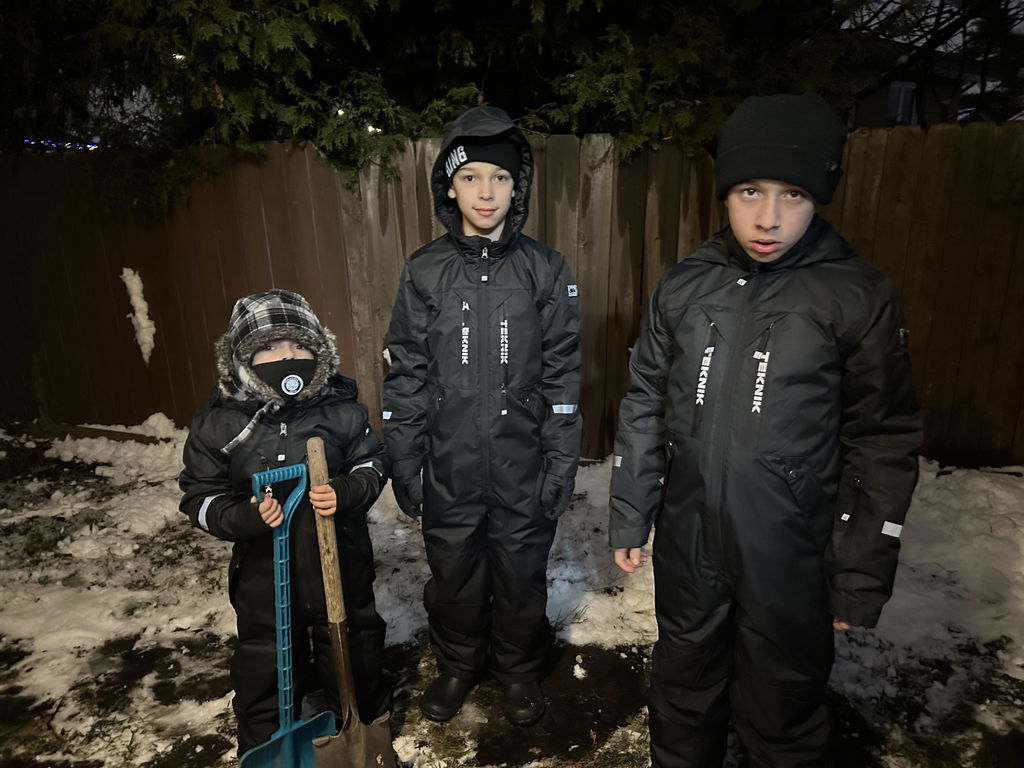
Ask your child to put the suit on alone and zip it. If they need help every time, or the hood slides over their eyes, the size or style isn't working. Shop by age and style in girls' snowsuits and boys' snowsuits. For older kids, the TEKNIK two-piece snowsuit in turquoise, orange and mauve is listed up to size 16.
Should You Size Up a Snowsuit for Growing Room?
Usually no. Buy the size that fits now, and get extra wear from adjustable features rather than extra fabric. An oversized suit leaves cold gaps at the neck and wrists, bunches at the knees and can make a small child trip.
Which features add growing room?
Look for adjustments listed on the product page. Some suits have sleeves that extend, hems that let down, adjustable suspenders or interior waist tabs. Our Two Piece Play Snowsuit Bright Pink page, for example, lists sleeves that extend 4 cm (1.5"), a two-level adjustable button hem that adds 7.6 cm (3") and removable adjustable suspenders. Not every suit has these, so check before you count on them.
When does sizing up make sense?
Size up only when your child's measurements are at the top of their current range and the next size still passes the fit test. If the larger suit covers the hands even with cuffs closed, or the crotch hangs near the knees, it's too big for this season.
What If Your Child Is Between Sizes?
When your child falls between two sizes, decide by the measurement that matters most for the style, then test both sizes with movement. For a one-piece, torso length usually decides. For a two-piece, you can check the jacket and pants separately.
| Situation | What to check | Likely choice |
|---|---|---|
| Height at the top of a size | Torso pull during a squat, wrist coverage when arms are raised | Larger size, if hems and cuffs still stay controlled |
| Height mid-range, chest larger | Zipper strain over a fleece layer | Larger size, or a cut with more room in the chest |
| Tall and slim | Waist and seat bagginess in the larger size | Size for height; use waist or suspender adjustments |
| Long torso, shorter legs | One-piece crotch pulling vs pant length | Often easier in a two-piece with adjustable suspenders |
| Brand says "fits generously" | Sleeve and leg length in the usual size | Stay with the measured size |
How Much Room Should a Snowsuit Leave for Layers?
A snowsuit should leave room for a thin base layer and one warm mid layer, not a stack of sweaters. Parachute, Canada's injury prevention charity, says "a few lighter layers protect better than one heavy garment," and suggests an absorbent synthetic layer next to the skin, a warmer middle layer and a water-resistant outer layer. The snowsuit is that outer layer.
The AAP gives the same advice: "Wearing several thin layers will help keep kids warm and dry." The Canadian Paediatric Society adds that "if your child's feet and hands are warm, what they are wearing is usually good," and that a child who is "dressed too warm" could sweat and feel colder when they stop playing.
So always test size over the real outfit: a base layer plus a fleece or light sweater. Testing over only a T-shirt makes a borderline size look roomier than it will be in January. Testing over a bulky hoodie does the opposite. For layer-by-layer ideas, read our layering guide for changing weather.
How Do One-Piece and Two-Piece Snowsuits Fit Differently?
A one-piece fits on one key measurement, torso length from shoulder to crotch, while a two-piece lets the jacket and pants fit on their own. Both use the same brand size chart, but you check different points.
| Fit checkpoint | One-piece snowsuit | Two-piece snowsuit |
|---|---|---|
| Torso | No pulling at the shoulders or crotch when your child squats or reaches up | Jacket stays over the pants, or over the bib, when arms are raised |
| Waist | Interior waist adjustment, if the suit has one, keeps it from sagging | Elastic waist or suspenders sit comfortably, without pulling the crotch up |
| Sleeves | Reach the wrist bone with arms raised | Same check, done on the jacket alone |
| Legs | Hem covers the boot top; crotch doesn't hang low | Pant length adjusts separately from the jacket |
| Works well for | Babies, toddlers and deep-snow play | Kids with a long torso or short legs, potty training, school |
A one-piece keeps snow out of the waist, but a child with a long torso may need the next size even when height says otherwise. A two-piece forgives uneven proportions because the jacket and pants fit separately. Bib-style pants add torso coverage. Don't tighten suspenders so much that the crotch pulls up. Compare styles in one-piece snowsuits and two-piece snowsuits, or read one-piece vs two-piece snowsuits for the features behind warmth.

How Do You Test Snowsuit Fit at Home?
Dress your child in their usual base and mid layers, put on boots and mittens, zip the suit fully and run a five-move test. Leave the tags on until you're done. Do these moves:
- Reach: Arms straight overhead. Sleeves should still reach the wrists, and the jacket or torso shouldn't ride up and expose the back.
- Squat: A full, deep squat. Watch for the crotch pulling tight or the back seam straining.
- Hug: Arms crossed in a big self-hug. The shoulders and back shouldn't feel tight.
- Walk and climb: A few stairs, or a step up onto the couch. Hems shouldn't catch under the boot heel.
- Sit and twist: Sit on the floor and turn side to side. Your child should be able to stand back up without help.
Then check the hood. It should move with the head and not fall over the eyes when your child looks sideways. Last, check that the zipper closes over the layers without straining.
Is the snowsuit too small or too big?
| Checkpoint | Too small | Too big |
|---|---|---|
| Wrists | Skin shows when arms are raised | Sleeves cover the hands even with cuffs closed |
| Crotch | Pulls tight during a squat | Hangs low, near the knees |
| Ankles | Hem rides above the boot top | Hem drags or catches under the heel |
| Hood | Pulls back when arms rise | Falls over the eyes |
| Zipper | Strains over the usual layers | Fabric bunches heavily at the chest and knees |
One sign on its own isn't always a reason to change sizes, especially if an adjustment fixes it. Two or three signs together usually mean you need the other size.
How do boots and mittens change fit?
Always check snow pants with the winter boots your child will wear. A hem that looks long in socks may sit right over a boot. The Canadian Paediatric Society recommends boots "roomy enough for an extra pair of socks and to wiggle toes," so bring those boots to the fitting. If the suit has ankle snow gaiters, they should slip over the boot and stay put. At the wrists, the CPS says to "wear mittens instead of gloves so that fingers can be bunched together for warmth." Sleeves should overlap the mitten cuff without swallowing your child's hands.
Can Kids Wear a Snowsuit in a Car Seat?
Not under the harness, no matter how well the snowsuit fits outdoors. The American Academy of Pediatrics says that "as a general rule, bulky clothing, including winter coats and snowsuits, should not be worn underneath the harness of a car seat." The AAP explains that in a crash, "fluffy padding in a coat immediately flattens out from the force, leaving extra space under the harness."
Parachute says "car seat manufacturers warn against dressing children in bulky snowsuits in a car seat or booster seat," and suggests clothing "appropriate for spring or autumn in the car seat, such as an undershirt, hat and fleece layer," with a blanket over the buckled straps. Transport Canada notes that "bulky winter coats and snow suits may not work well when it comes to your child's car seat" and tells parents to follow the car seat manual.
The AAP's pinch test is a quick check: "If you can pinch the straps of the car seat harness, then it needs to be tightened to fit snugly against your child's chest." The AAP also warns that "if the item did not come with the car seat, it has not been crash tested," so check your car seat manual before using any add-on product, and plan car layers separately from outdoor sizing.
What Hood, Neck and Boot Details Should You Check During a Fitting?
While your child is wearing the suit, check the hood, neck and boots as well as size. Parachute recommends "hoods and jackets without drawstrings, as drawstrings are a safety hazard for children," and "tube-shaped neck warmers instead of scarves to avoid strangulation during play." The Canadian Paediatric Society says to remove drawstrings from younger children's clothing and use "Velcro or other snaps instead."
Parachute also warns against overly tight footwear: choose "boots that are dry and not too tight," and avoid extra-thick socks, which "can cause cold feet by restricting blood flow." If the snowsuit hem only fits over the boot when the boot is squeezed, fix the pant length, not the boot.
How Often Should You Recheck Snowsuit Fit?
Recheck fit at the start of every season and again midwinter. Watch for wrists showing when your child reaches, pants riding above the boots, the crotch pulling during play or a zipper that's suddenly hard to close. If the suit has let-down hems or extendable sleeves, that's the moment to use them.
Frequently Asked Questions
Should I buy a snowsuit one size bigger?
Only if your child measures at the top of their current size and the bigger suit still passes a movement test. If the brand says the suit fits generously, stay with the measured size and rely on any adjustable cuffs or hems for growth.
How much room should a snowsuit have?
Enough for a thin base layer and one warm mid layer. Sleeves should reach the wrists with arms raised, and hems should cover the boot top without dragging on the floor.
Are snowsuits sized by age or height?
Most brand charts list both, but height and chest are more reliable than age. Measure your child and use the chart for the exact brand you're buying.
Is a 24-month snowsuit the same as size 2?
Sometimes. On the Deux par Deux size guide, 24 months and size 2 share the same height range, 82 to 86 cm, but other brands differ. Compare measurements, not labels.
How do I know if a one-piece snowsuit is too short in the torso?
Have your child squat and reach overhead. If the crotch pulls tight, the shoulders strain or the wrists show, the torso is too short.
Should my child wear a snowsuit in a car seat?
Not under the harness. The AAP says bulky clothing, including winter coats and snowsuits, should not be worn underneath the harness of a car seat. Buckle your child in thin layers, then add a blanket or coat over the straps.
What should my child wear under a snowsuit?
A few lighter layers rather than one heavy one. Parachute suggests an absorbent synthetic base layer and a warmer middle layer, with the snowsuit as the water-resistant outer layer.
Do one-piece and two-piece snowsuits use the same sizes?
They use the same brand chart, but fit differently. A one-piece depends on torso length, while a two-piece lets you check the jacket and pants separately.
The Bottom Line
Measure your child, read the exact brand's chart, test the suit over real layers with boots and mittens, and trust the five-move test over the age on the label. Choose the size that works this winter, and let adjustable cuffs, hems and suspenders handle growth. Keep car seat clothing separate from outdoor fit. When you're ready to compare, browse all kids' snowsuits, or see how lines and specs differ in our Deux par Deux snowsuit guide.
Sources
- American Academy of Pediatrics, HealthyChildren.org: Winter Car Seat Safety Tips
- American Academy of Pediatrics, HealthyChildren.org: Playing Outside in Winter: Tips to Keep Kids Warm and Safe
- Canadian Paediatric Society, Caring for Kids: Winter safety: Advice for parents and kids
- Parachute: Winter Outdoor Safety
- Parachute: Child Car Safety
- Transport Canada: Driving safely in winter
- Deux par Deux: Size Guide