Quick answer: The best snowsuit for ski school or sledding lets a child squat, kneel and climb without pulling, keeps snow out at the waist, wrists and boots, and has tough fabric on the knees and seat. Look for a snow skirt, ankle gaiters, cuffs that close over mitts and a fit with room for a thin base layer.
Ready to compare? Start with our best kids' snowsuit brands in Canada guide, or browse kids' snowsuits, girls' snowsuits and boys' snowsuits by size. This guide is for kids roughly 3 to 14 heading to ski lessons, the toboggan hill or both. For everyday winter wear for kids 4 to 14, our hub on how to choose the right snowsuit for your child covers the basics.
What makes a good snowsuit for ski school and sledding?
A good sledding snowsuit or snowsuit for ski school is built for movement and snow contact first, and bulk second. Kids in lessons spend hours bending, getting up after falls, riding lifts and waiting in line. On the sledding hill, they sit and kneel in snow, then trudge back up. The suit has to handle all of that without soaking through or riding up.
| Feature | Why it matters for ski school | Why it matters for sledding |
|---|---|---|
| Flexible fit at knees, hips and shoulders | Kids practice a "pizza" wedge, get up after falls and sit on lifts | Kids sit, kneel and climb back up the hill again and again |
| Snow skirt at the waist | Blocks snow during falls and lift rides | Stops snow from packing in when kids tumble off the sled |
| Ankle gaiters and ski-boot cuffs | Seal the pant leg over a ski boot | Keep snow out of winter boots during the climb |
| Reinforced knees and seat | Holds up to kneeling and sitting in snow | The seat takes the most wear on a sled or toboggan |
| Waterproof shell with sealed seams | Keeps kids dry through falls and lift rides | Keeps melting snow out when kids sit and kneel |
| Cuffs that close over mitts | Keeps wrists covered when poles and lifts are involved | Stops snow from sliding up sleeves when kids push off |
Warmth still matters, but the warmest suit is not automatically the right one. An active child produces a lot of heat on the way up a hill, and the Canadian Paediatric Society notes on its Caring for Kids winter safety page that a child who is dressed too warmly can sweat and then feel colder when they stop playing. That is the classic ski-school meltdown: sweaty during the lesson, shivering at the lift.
How is ski school different from sledding?
Ski school is a long, structured day with stop-and-go activity, while sledding is short bursts of hard work followed by fast, cold rides down. The same snowsuit can do both, but each activity puts the stress on a different part of the suit.
Ski school: long days, lots of waiting
Lessons often mean a few hours on the snow with breaks, lift rides and time standing in a group while the instructor explains the next drill. Kids sweat while side-stepping up a beginner slope, then cool off on the lift. That is why breathable outerwear and a moisture-managing base layer matter more for a lesson day than for a quick backyard play session.
Ski school also asks kids to be more independent. Instructors are managing a group, so a child who can zip their own jacket, close their own cuffs and pull mitts back on gets back to skiing faster. Practice those steps at home before the first lesson.
The American Academy of Pediatrics, on its HealthyChildren.org winter play page, recommends that kids learn to ski or snowboard from a qualified instructor in a program designed for children. The Canadian Paediatric Society's skiing and snowboarding safety page gives similar advice: sign new skiers up for lessons with a certified instructor.
Sledding: short, wet and hard on the seat
Sledding is tougher on fabric. Kids sit directly on snow, drag their knees, roll off at the bottom and climb back up through deep snow. Snow that gets inside a waistband or boot melts fast, and wet clothing is the problem. Parachute, Canada's injury prevention charity, says on its sledding and tobogganing page that many tobogganing injuries are cold-related, such as frostbite and hypothermia, and that children should get out of wet clothes and boots quickly after sledding.
How warm should a snowsuit for ski school be?
A snowsuit for ski school should be warm enough for your local conditions, paired with a breathable base layer and regular indoor breaks, rather than the heaviest suit you can find. Temperature ratings from brands are a useful comparison point, not a promise, because wind, wet snow and your child's activity level all change how warm they feel.
Look at three numbers when a brand lists them:
- Temperature rating: the brand's estimate of the conditions the suit is designed for.
- Waterproof rating (mm): how much water pressure the fabric resists. Higher numbers suit kids who sit and kneel in wet snow.
- Breathability rating (g/m²/24h): how much moisture vapour can escape. Higher numbers help kids who sweat during lessons.
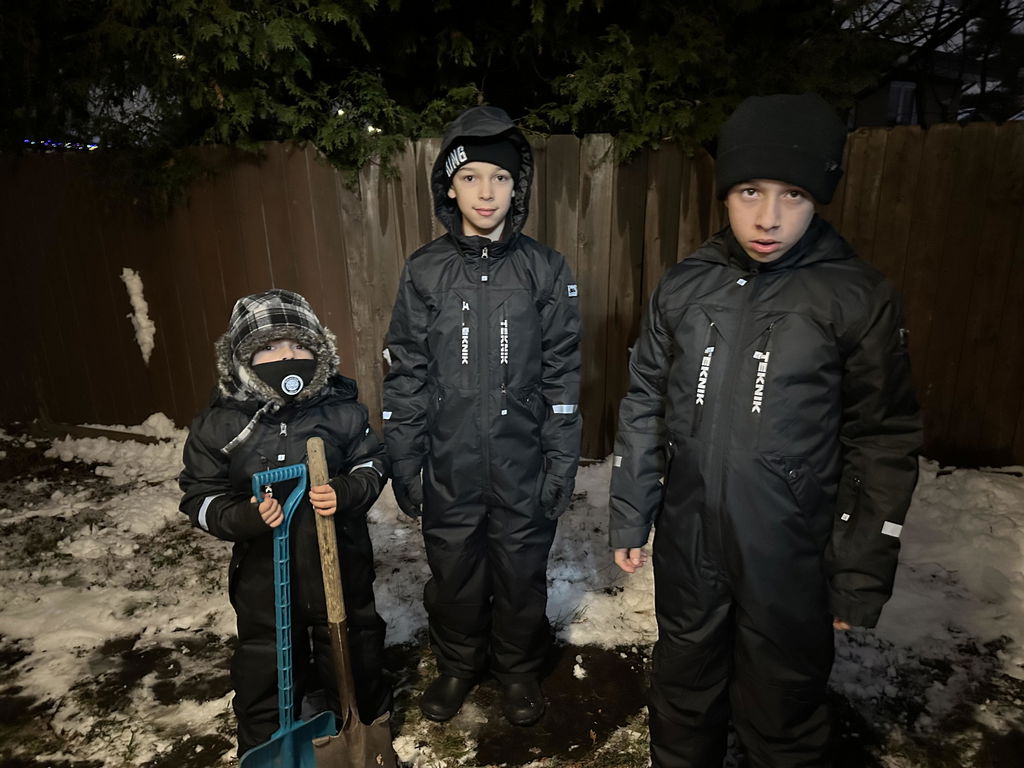
Here is a real example from our store. Deux par Deux lists its boys' DISCOVER two-piece snowsuit with a 10,000 mm waterproof coating and 5,000 g/m²/24h breathability, rated to -30°C (-22°F). Its TEKNIK line, which adds ski details such as ski-boot cuffs and a lift-pass pocket, lists 15,000 mm waterproofing and 15,000 g/m²/24h breathability. Deux par Deux describes this DISCOVER set as made for daycare yard time, preschool recess or a first sledding trip, while TEKNIK is its ski line.
Our guide to snowsuit warmth ratings and waterproof-breathable basics explains these numbers in more detail.

Which snowsuit features matter most on the ski hill?
On the ski hill, the features that matter most are a snow skirt, ski-boot cuffs, cuffs that close over mitts and a pocket for a lift pass. These small details decide whether a lesson day runs smoothly.
Is there a snow skirt and ankle gaiters?
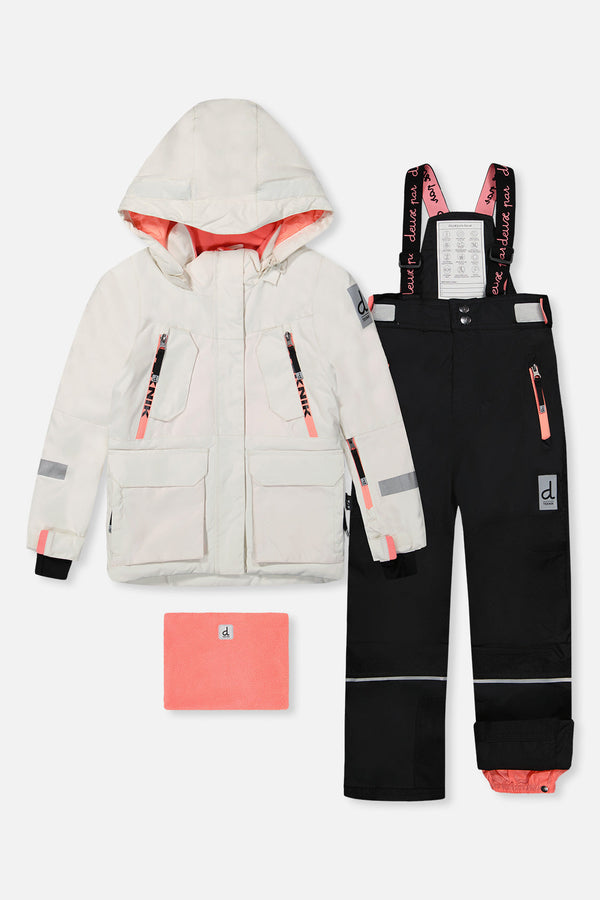
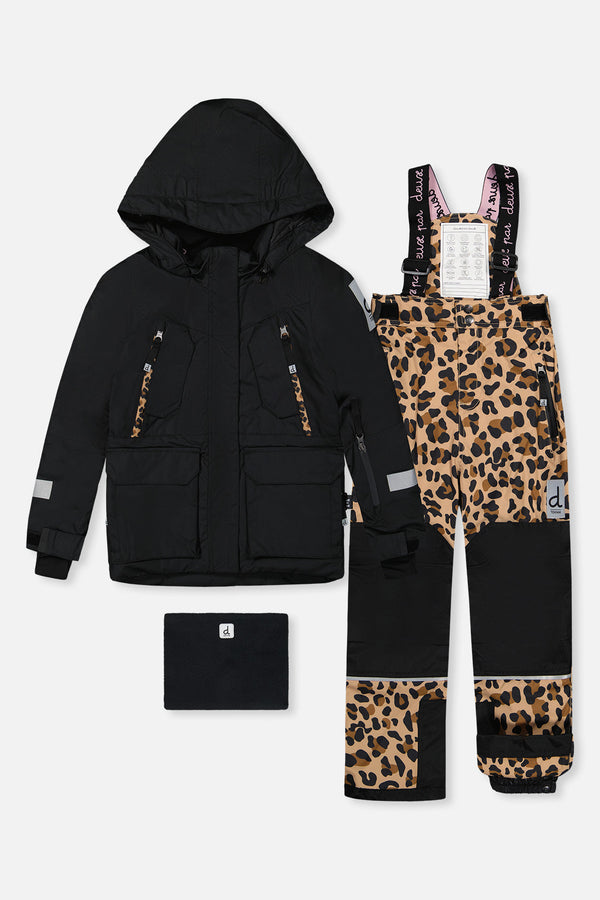
A snow skirt is an elastic band inside the jacket that grips the pants and blocks snow from going up the back during a fall. Ankle gaiters are inner cuffs that wrap around the boot. Deux par Deux lists an adjustable snow skirt, snap-close ankle gaiters with rubberized elastic and adjustable ski-boot cuffs on its TEKNIK sets, including the girls' TEKNIK two-piece snowsuit in black with pink and blue mountain-print pants. On a two-piece suit, the snow skirt is what closes the waist gap.
Can your child manage the cuffs and zippers?
Look for Velcro® cuff tabs, a large zipper pull and an inner stretch cuff that sits under the mitt. Kids in lessons pull mitts on and off often, and a cuff that seals quickly saves time on the lift line. Deux par Deux lists Velcro® cuff tabs with inner stretch cuffs on the TEKNIK jacket.
Is there somewhere to put a lift pass?
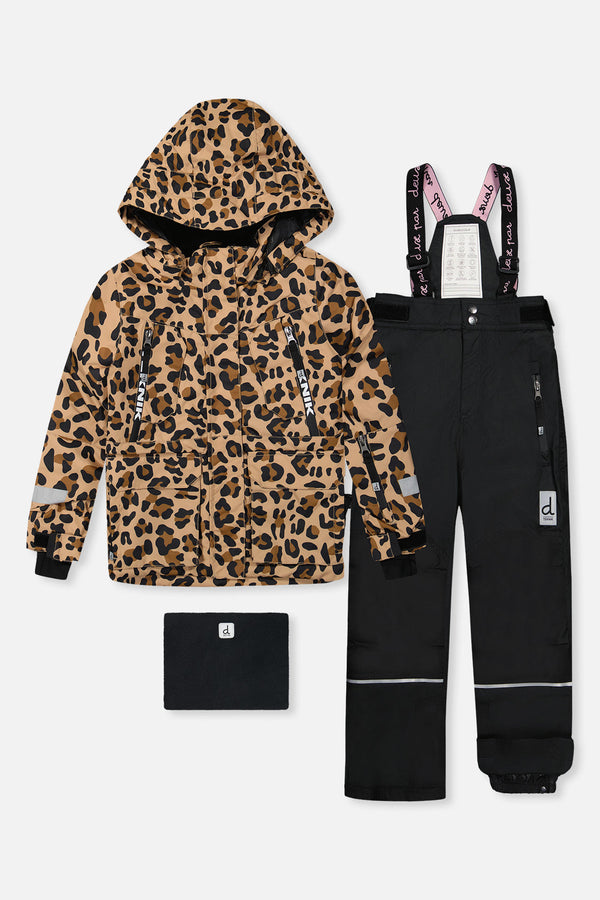
A sleeve or chest pocket for the lift pass keeps kids from unzipping their jacket at the gate. Deux par Deux lists a sleeve ski-pass pocket on the boys' TEKNIK two-piece snowsuit in black, beige and burgundy, along with waterproof zippered pockets and built-in backpack straps.
If your child only needs a jacket because they already own good snow pants, our guide to the best ski jackets for kids compares jacket features in depth.
Which snowsuit features matter most for sledding?
For sledding, the features that matter most are abrasion-resistant fabric on the seat and knees, a waterproof shell and a tight seal at the waist and ankles. Those are the spots that sit in the snow.
Are the seat and knees reinforced?
A sled seat and packed snow rub hard against snow pants. Reinforcement panels in a tougher fabric hold up better where kids sit and kneel. Deux par Deux lists Cordura® reinforcement at the knees, seat and hems on its TEKNIK sets, and 500-denier Cordura® on the legs and seat of the bib pants in its boys' DISCOVER two-piece snowsuit with skiing dinosaur print.
How should kids sit on a sled?
This is not about clothing, but it is worth teaching. The Canadian Paediatric Society advises children to always sit up or kneel on a sled, because lying down can increase the risk of injury to the head, spine and stomach. Parachute agrees that kneeling or sitting up is the safest position. That is another reason knee and seat fabric takes so much wear.
The Canadian Paediatric Society also says children under 5 should never go down a hill alone. The AAP recommends that children under age 12 always be supervised while sledding.
Should kids wear a one-piece or two-piece snowsuit for ski school?
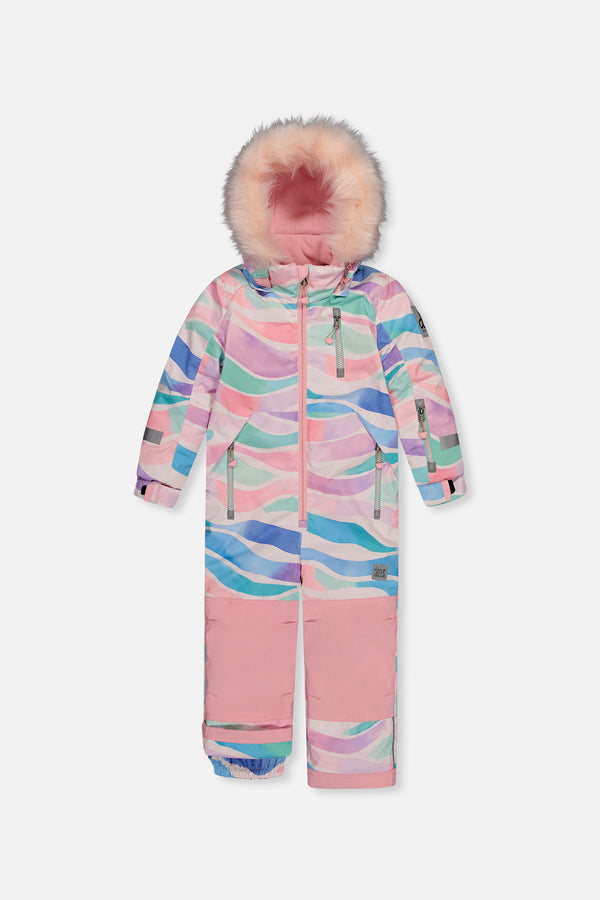
A two-piece suit is often easier for ski school because kids can take the jacket off at lunch and bathroom breaks are faster. A one-piece seals the waist completely, which some parents prefer for younger sledders. Our guide to one-piece vs two-piece snowsuits compares both in detail.
How should a snowsuit fit for skiing and sledding?
A snowsuit for skiing and sledding should let your child squat, kneel, lift each knee to the chest and reach forward without the fabric pulling tight at the shoulders, seat or crotch. Sleeves should reach the wrist bone with arms outstretched, and pant legs should sit over the boot without bunching under the heel.
Try the "ski day" fit test at home
Have your child put on the base layer and mid layer they will actually wear, plus their boots, then try these moves in the suit:
- Squat: can they squat as if getting up after a fall, without the seat pulling down?
- Knee lift: can they lift one knee high, like stepping onto a chairlift?
- Reach: with arms forward, do the sleeves still cover the wrists?
- Sit and kneel: can they sit on the floor and kneel without the jacket riding up?
- Zip and close: can they work the main zipper and cuffs with mitts on?
Squat, reach, sit: test the fit before ski day, not on the hill.
Should you size up a snowsuit for ski season?
Sizing up can leave extra fabric that catches on skis, drags under boots and lets snow in. Check the brand's own advice first. Deux par Deux says the TEKNIK and DISCOVER suits linked in this guide fit generously and advises not to size up. Instead, these suits have built-in growth room: Deux par Deux lists sleeves that extend 4 cm (1.5 in) and adjustable hems that add up to 7.6 cm (3 in) on TEKNIK, or 5.7 cm (2 1/4 in) on DISCOVER.
Measure your child and compare with our snowsuit sizing guide before you order.
What should kids wear under a snowsuit for ski lessons?
Under a snowsuit, kids need a moisture-wicking base layer, an optional light mid layer for very cold days, one pair of warm socks and a neck warmer. Skip cotton next to the skin, because it holds sweat.
Parachute's winter outdoor safety page recommends loose layers: an absorbent synthetic fabric next to the skin, a warmer middle layer and a water-resistant outer layer. It also notes that a few lighter layers protect better than one heavy garment.
- Base layer: a thermal top and pants. Deux par Deux lists its boys' merino blend thermal underwear set in black as 60% polyester and 40% merino wool with a brushed interior. Browse more in girls' base layers and boys' base layers.
- Mid layer: a thin fleece on very cold days, removed if your child runs warm.
- Socks: Parachute says a single pair of wool or wool-blend socks is better than cotton, and that extra-thick socks can cause cold feet by restricting blood flow around the toes. That matters even more in snug ski boots.
- Neck: both the Canadian Paediatric Society and Parachute recommend a neck warmer instead of a scarf.
- Hands: the Canadian Paediatric Society says mittens are better than gloves in really cold temperatures, because fingers can bunch together for warmth. Find pairs in kids' gloves and mittens.
For a full breakdown by temperature, see what to wear under a snowsuit: the no-sweat layering formula.

Do kids need a helmet for sledding and ski school?
Yes. Canadian pediatric and injury-prevention groups recommend helmets for both skiing and sledding. The AAP says all skiers and snowboarders should wear helmets, and the Canadian Paediatric Society recommends a helmet designed specifically for skiing and snowboarding. The AAP adds that ski facilities should require helmet use, so check your program's own rules too.
For sledding, the Canadian Paediatric Society says to always wear a ski or hockey helmet, not a bicycle helmet, because bicycle helmets are only tested up to -10°C (14°F) and need to be replaced after one crash. Parachute's helmets for winter activities page recommends ski helmets for sledding because they are designed for cold weather and for similar falls and speeds.
How should a ski helmet fit?
Parachute says a ski or snowboard helmet should rest two fingers' width above the eyebrow and be snug, with only one finger's width under the chinstrap. If your child wears goggles, there should be little or no gap between the goggles and the helmet. Parachute also advises replacing a ski helmet after a fall or collision, even if it looks undamaged, and replacing any helmet older than five years.
How cold is too cold for ski school or sledding?
Canadian and US health groups set slightly different limits, but they agree on the range. Use these thresholds as a guide, along with your ski school's own policy:
| Temperature or wind chill | What the source says |
|---|---|
| -15°C (5°F) or colder | Canadian Paediatric Society: plan to reduce the time children spend outside |
| Below -25°C (-13°F) | Parachute: children should play indoors |
| -27°C (-16°F) or lower | Canadian Paediatric Society: consider keeping children indoors, because exposed skin begins to freeze |
| Below -15°F (about -26°C) | AAP: playing outside should generally be avoided |
Wind chill matters as much as the air temperature: the Canadian Paediatric Society's limits apply to the temperature or the wind chill. Check the forecast before you leave, as the Canadian Paediatric Society recommends, and pack an extra hat and mitts.
What are the signs of frostbite?
The Canadian Paediatric Society's frostbite page lists the cheeks, ears, nose, fingers and toes as the most common places for frostbite. Skin first turns red and swollen and stings or burns; frozen skin has no feeling and looks shiny and white. The AAP adds that frostbitten skin may look white or pale grey.
If you suspect frostbite, bring your child indoors, remove wet clothing and warm the area slowly with warm (not hot) water. Do not rub the skin. The Canadian Paediatric Society says to seek medical advice immediately if your child's skin is white, waxy or numb, and the AAP advises calling your pediatrician if pain or numbness lasts more than a few minutes. When in doubt, see a doctor.
What should you pack for a ski-school or sledding day?
Pack spare dry layers, a second pair of mitts and a hat, a neck warmer, goggles and sunscreen, so wet gear can come off at lunch.
- Spare mitts and hat: the Canadian Paediatric Society suggests packing extra hats and mitts.
- Dry socks and base layer: for lunch or the ride home, since wet clothing should come off right away.
- Neck warmer: in place of a scarf.
- Goggles or sunglasses: Parachute recommends UV-protective eyewear to guard against sun reflecting off snow, and the AAP recommends eye protection for skiers and snowboarders.
- Sunscreen: both the Canadian Paediatric Society and Parachute recommend it, even on cloudy days.
- A warm drink and snack: Parachute recommends warm fluids and frequent breaks to warm up.
- Name labels: on mitts, helmet, goggles and the snowsuit itself. In a ski school, a lot of gear looks the same.
Accessories like toques and neck warmers are in our winter accessories collection.
Which Jenni Kidz snowsuits work for ski school and sledding?
Choose by your child's age and how much skiing they will do. Product details below come from each product page, as listed by the brand.
Preschoolers (sizes 2 to 8): first lessons and backyard sledding
The boys' DISCOVER skiing dinosaur snowsuit pairs a grey printed jacket with navy bib pants. Deux par Deux lists fleece lining, an adjustable snow skirt, ankle snow gaiters, reflective details and 500-denier Cordura® on the legs and seat. It suits little kids whose winter is mostly play, sledding and first ski lessons.
Sizes 4 and up: regular ski lessons
Both TEKNIK sets we link here list the ski details covered above: a lift-pass pocket, ski-boot cuffs, Velcro® cuff tabs and Cordura® on the knees, seat and hems. Choose the girls' TEKNIK snowsuit in black with mountain-print pants or the boys' TEKNIK snowsuit in black, beige and burgundy. Deux par Deux lists recycled PrimaLoft® insulation and taped critical seams on both, and a -30°C (-22°F) rating on the girls' set.
See more styles in girls' snowsuits and boys' snowsuits, the full kids' snowsuit collection or the Deux par Deux collection. Shopping by gender? See our girls' snowsuit buying guide and boys' snowsuit buying guide. For a side-by-side look at brands, our Canadian kids' snowsuit brand comparison is the place to start.
Ski school and sledding snowsuit FAQ
What is the best snowsuit for ski school?
The best snowsuit for ski school lets your child squat, kneel and get up after falls without pulling, and has a snow skirt, ankle gaiters, reinforced knees and seat, and cuffs that close over mitts. A two-piece suit is easier for lunch and bathroom breaks.
Is a one-piece or two-piece snowsuit better for sledding?
Both work. A one-piece seals the waist completely, which helps younger sledders who tumble often. A two-piece with bib pants and a snow skirt also keeps snow out and lets older kids remove the jacket indoors.
Should I buy a snowsuit a size up for ski season?
Check the brand's advice first. Deux par Deux says the TEKNIK and DISCOVER suits we carry fit generously and advises not to size up. Extra length can drag under boots and let snow in, so measure your child and use the brand's size chart.
What should my child wear under a snowsuit for skiing?
Use a moisture-wicking base layer, a light fleece only on very cold days, one pair of wool or wool-blend socks and a neck warmer. Avoid cotton next to the skin, because it holds sweat.
Does my child need a helmet for sledding?
The Canadian Paediatric Society and Parachute recommend a helmet for sledding. The Canadian Paediatric Society says to use a ski or hockey helmet rather than a bicycle helmet, because bicycle helmets are only tested up to -10°C (14°F).
How cold is too cold for kids to ski or sled?
The Canadian Paediatric Society suggests reducing outdoor time at -15°C (5°F) or colder and considering keeping children indoors at -27°C (-16°F) or lower, including wind chill. Parachute advises playing indoors below -25°C (-13°F).
How do I know if my child is dressed warmly enough?
The Canadian Paediatric Society says that if your child's hands and feet are warm, what they are wearing is usually good, and that a child dressed too warmly can sweat and then feel colder when they stop playing.
Sources
- Canadian Paediatric Society, Caring for Kids: Winter safety: Advice for parents and kids
- Canadian Paediatric Society, Caring for Kids: Frostbite
- Canadian Paediatric Society, Caring for Kids: Skiing and snowboarding safety
- American Academy of Pediatrics, HealthyChildren.org: Playing Outside in Winter: Tips to Keep Kids Warm & Safe
- Parachute: Sledding and tobogganing
- Parachute: Helmets for winter activities
- Parachute: Winter outdoor safety
- Parachute: Skiing and snowboarding
This article is general information, not medical advice. If you are worried about frostbite, cold exposure or an injury, contact a doctor.