Quick answer: Bamboo sleepers can be warm enough for winter, but the fabric name alone does not decide it. Most "bamboo" sleepers are stretchy rayon or viscose knits with no listed warmth rating, so in a cool room they work best as a snug base layer under a sleep sack. Dress for the room, then check your baby's chest or neck.
This guide answers how warm a bamboo sleeper (footie pajamas made from bamboo-derived rayon or viscose) is on a winter night, for babies from 0 to 24 months and toddlers moving into two-piece PJs. To compare styles as you read, browse bamboo baby and kids clothing at Jenni Kidz.
General information, not medical advice. If your baby seems unwell, has a fever, or you are unsure how to dress them for sleep, talk to your doctor, nurse or public health nurse.
Are Bamboo Sleepers Warm Enough for Winter?
Yes, a bamboo sleeper can be part of a warm enough winter setup, but on its own it is just one layer. Warmth at night comes from the whole setup: the room temperature, the thickness of the knit, how well the sleeper fits, and whether your baby also wears a sleep sack.
The bamboo sleepers at Jenni Kidz are rayon or viscose blends with a little spandex for stretch. Kyte Baby, for example, lists its zippered footies as 97% rayon made from bamboo and 3% spandex, and Angel Dear lists 95% viscose from bamboo and 5% spandex. Neither brand lists a warmth rating or TOG value for these sleepers. That means you should treat a bamboo sleeper the way you would treat any one-layer knit sleeper: comfortable on its own in a warm room, and a base layer when the nursery is cool.
What Does "Bamboo" Mean on a Sleeper Label?
On most baby clothing, "bamboo" means a rayon or viscose fibre that was made using bamboo as the raw material. It does not mean the fabric is woven from raw bamboo fibre, and it does not mean the plant's natural traits carry over to the finished cloth.
The U.S. Federal Trade Commission (FTC) says that most "bamboo" textile products, if not all, are really rayon, and that there is no trace of the original plant in the finished rayon. The FTC says these products should be labelled with the generic fibre name, such as "rayon made from bamboo." In Canada, the Competition Bureau says the end product is rayon or viscose that contains no trace of the bamboo plant or its antimicrobial properties, and that labels should read "rayon from bamboo" or "viscose from bamboo."
Here is how the bamboo sleepwear at Jenni Kidz is described on the live product pages:
| Brand and style | Fibre content the listing gives | Fit and closure details listed |
|---|---|---|
| Kyte Baby Zippered Footie (Barbie™ Beach) | 97% rayon made from bamboo, 3% spandex | Full-length zipper, long sleeves, enclosed feet |
| Kyte Baby Zippered Footie (The Very Hungry Caterpillar™) | 97% bamboo rayon, 3% spandex | J-shaped double zipper, enclosed feet |
| Kyte Baby Zippered Romper | 97% bamboo rayon, 3% spandex | Front zipper, footless legs with ankle cuffs |
| Angel Dear Bamboo Ruffle Footie | 95% viscose from bamboo, 5% spandex | Zip front, footed legs, snug-fit label |
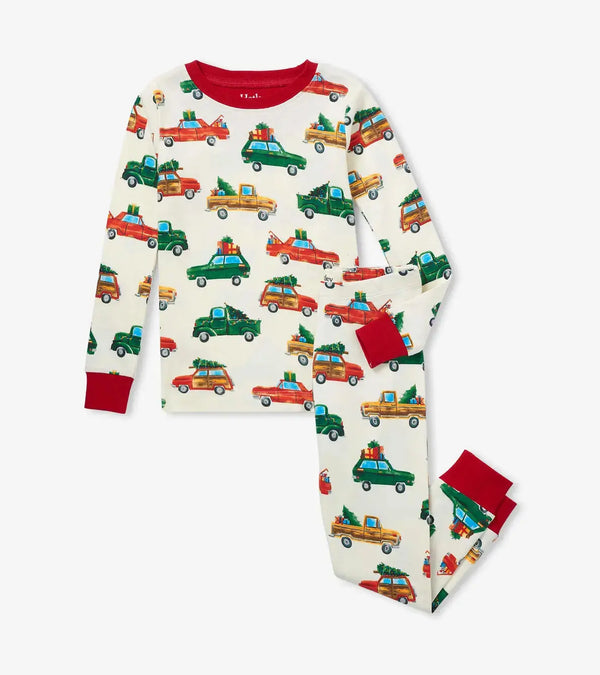
| Hatley Trucks Bamboo Pajama Set (toddler and kids) | 95% viscose from bamboo, 5% spandex | Long-sleeve top and full-length pants |
What this means for you: read the fibre line, not just the word "bamboo" in the product name. And be cautious with plant-based health claims about bamboo sleepwear, since the Competition Bureau says the processed fabric keeps no trace of the plant's antimicrobial properties.
How Does Bamboo Compare With Cotton and Fleece for Winter Sleep?
Bamboo rayon, cotton and polyester plush or fleece can all show up in a winter sleep setup, but they usually play different roles. Bamboo and cotton knits are most often the base layer next to the skin, while plush or fleece is more often the outer layer, such as a sleep sack.
| Fabric | Where you usually see it in baby sleepwear | What to check before winter |
|---|---|---|
| Bamboo rayon or viscose knit | Footies, zip rompers and two-piece PJs, often blended with 3–5% spandex for stretch | Fibre line on the label, snug fit, and the care label (some brands advise against the dryer) |
| Cotton knit | Snap or zip footies, two-piece sets, sleep sack linings | Snug fit for sleepwear, knit thickness, shrinkage after washing |
| Polyester plush or fleece | Sleep sack outers and some sleepers | Whether your baby's base layer plus this layer is too much for the room |
Two points matter more than the fibre name. First, the brands we stock do not give their bamboo sleepers a warmth rating, so the part you can adjust is the number and weight of layers, such as adding a sleep sack. Second, fit counts. Health Canada notes on its children's sleepwear page that cotton, cotton-blend and rayon fabrics tend to catch fire and burn more quickly than most synthetic materials, and that loose-fitting sleepwear may be more likely to catch fire than tight-fitting styles. Since bamboo sleepwear is usually rayon or viscose, a close fit is part of choosing it, not just a style preference. We cover the rules in detail in Do kids' pajamas have to be flame retardant?
How Should You Dress a Baby in a Bamboo Sleeper for the Room Temperature?
Start with the room, then build the outfit. The American Academy of Pediatrics (AAP) says on HealthyChildren.org that, in general, you should dress your baby in only one layer more than you are wearing, and that you can use layers of clothing or a wearable blanket. The Public Health Agency of Canada advises on its dressing your baby for sleep page to dress your baby so they are warm but not hot, with sleepwear that suits the room temperature.
Canadian and U.S. guidance does not give a single number, but the UK's NHS advises keeping a baby's room at about 16 to 20°C (roughly 61 to 68°F) and checking it with a room thermometer. The Canadian Paediatric Society (CPS) puts it more simply on Caring for Kids: keep the room at a comfortable temperature, and if it is comfortable for you, it will be comfortable for your baby too.
Here is one way to apply the AAP's "one more layer" idea with a bamboo sleeper. These are example setups, not fixed rules; always check your baby after they settle.
| How the room feels to you | What you might wear to bed | Example bamboo setup for baby |
|---|---|---|
| Warm (at or above the NHS range) | Light sleepwear | Bamboo footie or zip romper on its own, or with a lightweight sleep sack if you want an extra layer |
| Comfortable (inside the NHS range) | Pajamas and maybe a light cover | Bamboo footie plus a sleep sack chosen for the room |
| Cool (below the NHS range) | Warm pajamas and a heavier cover | Bamboo footie plus a warmer sleep sack, such as a plush one; consider warming the room rather than adding more layers |
For the full cold-nursery plan, including fleece and two-piece pajamas, see our main guide, What baby pajamas are best for cold weather?
How Can You Tell if Your Baby Is Too Hot or Too Cold?
Feel your baby's chest or the back of the neck, not the hands or feet. The NHS says to check your baby's temperature this way and not to worry if their hands or feet feel cool, because that is normal. The AAP lists sweating, a hot chest and flushed skin as signs of overheating. If your baby's skin is hot or sweaty, the NHS advises removing one or more layers of clothing or bedding.
If the chest feels comfortably warm, cool fingers or feet alone are not a reason to add a layer. If you think your baby is cold, adjust the room or the sleep sack rather than adding a loose blanket.

A bamboo sleeper does not change the basic sleep-space rules: no loose blanket (the Public Health Agency of Canada says that if you use a sleep sack, you don't need one), no hat indoors, no outerwear and nothing weighted. For the full list and the reasons behind it, see what babies should not wear to bed in winter.
For when a blanket becomes an option for an older child, see When can babies sleep with a blanket?
Footed or Footless: Which Bamboo Style Suits Winter Nights?
For most winter nights, a footed bamboo sleeper is the simpler choice, because it covers the feet without socks. A footless zip romper works well when your baby runs warm, when you want to pair it with socks, or when your baby is long for the size and the feet are getting tight.
- Footed (footie pajamas): Kyte Baby's Zippered Footie in Barbie™ Beach has long sleeves, enclosed feet and a full-length zipper that opens from collar to ankle, according to the listing.
- Footless (zip romper): The Kyte Baby Zippered Romper in The Very Hungry Caterpillar™ and Friends has footless legs that finish in ankle cuffs, so the listing suggests socks underneath. The Kyte Baby Zippered Romper in Dolphin is the same footless cut in a white dolphin print.
Kyte Baby lists a J-shaped double zipper on The Very Hungry Caterpillar™ footie, which can make night changes quicker. Whatever you choose, toes pressed against the end of a footie are a sign it is time for the next size. Compare more styles in baby footies and sleepers. For newborn fit and the footed-versus-footless question in the first weeks, read Can newborns sleep in footie pajamas?
How Should a Bamboo Sleeper Fit?
A bamboo sleeper should fit close to the body, without bagging at the chest or legs, while still letting your baby bend their knees and move their arms. The Public Health Agency of Canada recommends simple, fitted sleepwear, like a sleeper, and CPS also recommends properly fitted sleepwear for sleep.
Fit has a second job in sleepwear. In the United States, the Consumer Product Safety Commission (CPSC) announced in 2000 that snug-fitting cotton and cotton-blend children's sleepwear must carry a yellow hangtag saying the garment should fit snugly and is not flame resistant, and that a loose-fitting garment is more likely to catch fire, plus a permanent label reading "Wear snug-fitting. Not flame resistant." (see the CPSC announcement). You may see similar wording on bamboo sleepers too: Angel Dear's bamboo ruffle footie listing includes a note that the garment should fit snugly and is not flame resistant. Health Canada adds that sleepwear that is too big can come into contact with an ignition source more easily, and advises size-appropriate sleepwear.
Practical fit tips for bamboo:
- Buy the size that fits now. The 3–5% spandex in most bamboo knits gives stretch, so you do not need to size up for comfort.
- Check the length, not just the age on the tag. Long babies often outgrow the feet of a footie before the body feels tight.
- Check closures regularly. The Public Health Agency of Canada advises fixing loose buttons, snaps, zipper pulls and threads.
If your toddler's bamboo PJs feel tighter than their daywear, that is by design. We explain why in Why are kids' pajamas so tight?, and our baby clothes size guide covers sizing from newborn to 24 months.
Can You Put a Sleep Sack Over a Bamboo Sleeper?
Yes. A sleep sack (also called a wearable blanket) over a bamboo sleeper is a simple way to add warmth for babies, because it replaces a loose blanket. The AAP says you can dress your baby in layers or use a wearable blanket, and the Public Health Agency of Canada says that if you use a sleep sack, you don't need a blanket.
Two things to get right:
- Match the sack to the room. The Public Health Agency of Canada advises choosing a sleep sack that suits the room temperature, and using a lightweight one if the room is warm.
- Get the size right. CPS and the Public Health Agency of Canada both warn that if a sleep sack is too big, your baby can slip down inside it. CPS adds that a sack that is too tight may stop your baby from moving their hips and legs freely.
Sleep sacks at Jenni Kidz come in different weights. Deux par Deux lists its Plush Sleep Sack in Off-White and Plush Sleep Sack in Sky Blue with a 100% polyester plush outer, a 100% cotton lining and a full-length zipper, in sizes 0/6, 6/18 and 18/36 months. For a lighter layer, Deux par Deux lists its Organic Cotton Sleep Sack in Pink Printed Flowers with an outer of 96% organic cotton and 4% elastane and a 100% cotton lining. Compare all styles in baby sleep sacks.
A quick way to choose: in a cool room, a bamboo footie under a plush sack is one layer more than a bamboo footie alone; in a warmer room, a cotton sack or no sack may be enough. Then do the chest check after your baby settles.

Are Bamboo Pajamas Warm Enough for Toddlers?
Yes, in the same way they work for babies: as a snug base layer, with warmth added for the room. What changes is the style, as toddlers move from footies to two-piece PJs.
- Footies up to 24 months: Kyte Baby lists its zippered footies and rompers in sizes 3-6M, 6-12M, 12-18M and 18-24M.
- Two-piece bamboo PJs from 2Y: Hatley lists its Trucks Bamboo Pajama Set as 95% viscose from bamboo and 5% spandex, with a long-sleeve top and matching full-length pants, in sizes 2Y to 12Y.
- Sleep sacks to 36 months: the Deux par Deux plush sleep sacks above come in an 18/36-month size.
If your toddler kicks off covers, a sleep sack in the 18/36-month size is one way to keep a layer on through the night. With a two-piece set, also check that the top stays tucked and the waist and cuffs sit close, so the midriff stays covered when your toddler moves around. For more two-piece options, browse boys pajamas and girls pajamas.
How Do You Wash Bamboo Sleepers So They Stay Soft?
Follow the care label for each sleeper, because brands give different instructions even for similar bamboo blends. The most common advice is a cold, gentle wash and low or no heat when drying.
| Brand and style | Care instructions the listing gives |
|---|---|
| Kyte Baby Zippered Footies | Wash cold on a gentle cycle with similar fabrics; turn off the agitator if that is an option; dryer not recommended, hang or lay flat to dry; avoid care products with harsh chemicals, additives, optical brighteners and bleach |
| Kyte Baby Zippered Rompers | Machine wash gentle with fragrance-free detergent; lay flat or hang to dry |
| Hatley Trucks Bamboo Pajama Set | Machine wash cold, gentle cycle; tumble dry low |
Because the brands differ on the dryer, check each label before laundry day. For stain tips, detergent choices and drying in more depth, see our guide to washing bamboo baby clothes.
How Do You Choose a Bamboo Sleeper for Winter?
Choose a bamboo sleeper the same way you would choose any winter sleepwear: check the room, the label, the fit and the layer that goes on top. Use these steps:
- Check your nursery temperature. Use a room thermometer and compare it with the UK NHS range of about 16 to 20°C.
- Read the fibre line. Look for wording like "rayon made from bamboo" or "viscose from bamboo," and note the spandex percentage.
- Pick footed or footless. Footed covers the feet without socks; footless suits warm sleepers and long babies.
- Choose the current size. Aim for a close fit with room to move, not a size up.
- Plan the top layer. Pair the sleeper with a sleep sack that suits the room, in the correct size, instead of a loose blanket.
- Check the care label. Make sure the drying instructions fit your laundry routine.
- Check your baby after they settle. Feel the chest or back of the neck and adjust layers if they are hot or sweaty.
Mistakes to skip: treating "bamboo" as a warmth rating, sizing up because the knit stretches, adding a blanket or hat instead of a sleep sack, and machine-drying a sleeper whose label says not to.
Related Jenni Kidz Sleepwear Guides
These guides go deeper on topics this post only touches:
- What baby pajamas are best for cold weather? Our main winter sleepwear guide. It compares one-piece and two-piece styles and fabrics, and explains sleep-sack pairing for a cold room.
- How to choose comfortable baby pajamas. A year-round guide to size, fabric, closures and fit checks. Read it if comfort, not warmth, is your main question.
- Can newborns sleep in footie pajamas? Covers newborn footie fit and which first size to buy. It also explains layering a sleep sack over a footie.
- Do kids' pajamas have to be flame retardant? Explains Canadian and U.S. sleepwear rules. It also covers what snug-fit labels mean.
- How to wash bamboo baby clothes. A step-by-step laundry guide for bamboo pieces. It covers care labels, drying and shrinkage.
- How to dress a newborn for sleep in winter. Our 0–3 month winter sleep guide. Start there if your baby is a newborn.
Bamboo Sleeper FAQs
Are bamboo sleepers warm enough for winter?
They can be, as part of a full setup. Most bamboo sleepers are stretchy rayon or viscose knits with no listed warmth rating, so in a cool room they work best as a snug base layer under a sleep sack. Dress for the room temperature and check your baby's chest or the back of the neck.
Is bamboo warmer than cotton for baby pajamas?
Not by name alone. Neither Kyte Baby nor Angel Dear lists a warmth rating or TOG value for its bamboo sleepers, so the fibre name is not a warmth measure. Compare the fibre content and style on the label, then build the setup around your room temperature.
Is bamboo fabric really bamboo?
Usually it is rayon or viscose made using bamboo as the raw material. The FTC says most bamboo textiles are really rayon, and Canada's Competition Bureau says labels should read "rayon from bamboo" or "viscose from bamboo."
What should a baby wear under a sleep sack in winter?
A snug sleeper, such as a bamboo or cotton footie, is a common base layer. The AAP says to dress your baby in only one layer more than you are wearing, so choose the sleep sack weight based on how the room feels to you.
How do I know if my baby is too hot in a bamboo sleeper?
Feel the chest or the back of the neck. The AAP lists sweating, a hot chest and flushed skin as signs of overheating, and the NHS says cool hands and feet are normal. If your baby's skin is hot or sweaty, remove a layer.
Should bamboo sleepers fit tight?
They should fit snugly while still letting your baby move. The Public Health Agency of Canada recommends simple, fitted sleepwear, like a sleeper, and Health Canada notes that loose-fitting sleepwear may be more likely to catch fire than tight-fitting styles.
Can I put bamboo sleepers in the dryer?
It depends on the brand. Kyte Baby says the dryer is not recommended and advises hanging or laying its footies flat to dry, while Hatley lists tumble dry low for its Trucks bamboo pajama set. Always follow the care label.
Sources
- U.S. Federal Trade Commission (FTC) — How to Avoid Bamboozling Your Customers
- Competition Bureau Canada — Don't be bamboozled: the real deal with "bamboo fabric"
- American Academy of Pediatrics, HealthyChildren.org — A Parent's Guide to Safe Sleep
- Public Health Agency of Canada — Dressing your baby for sleep
- Canadian Paediatric Society, Caring for Kids — Safe sleep for babies
- NHS — Sudden infant death syndrome (SIDS)
- Health Canada — Children's sleepwear safety
- U.S. Consumer Product Safety Commission (CPSC) — New Labels on Children's Sleepwear Alert Parents to Fire Dangers (2000)