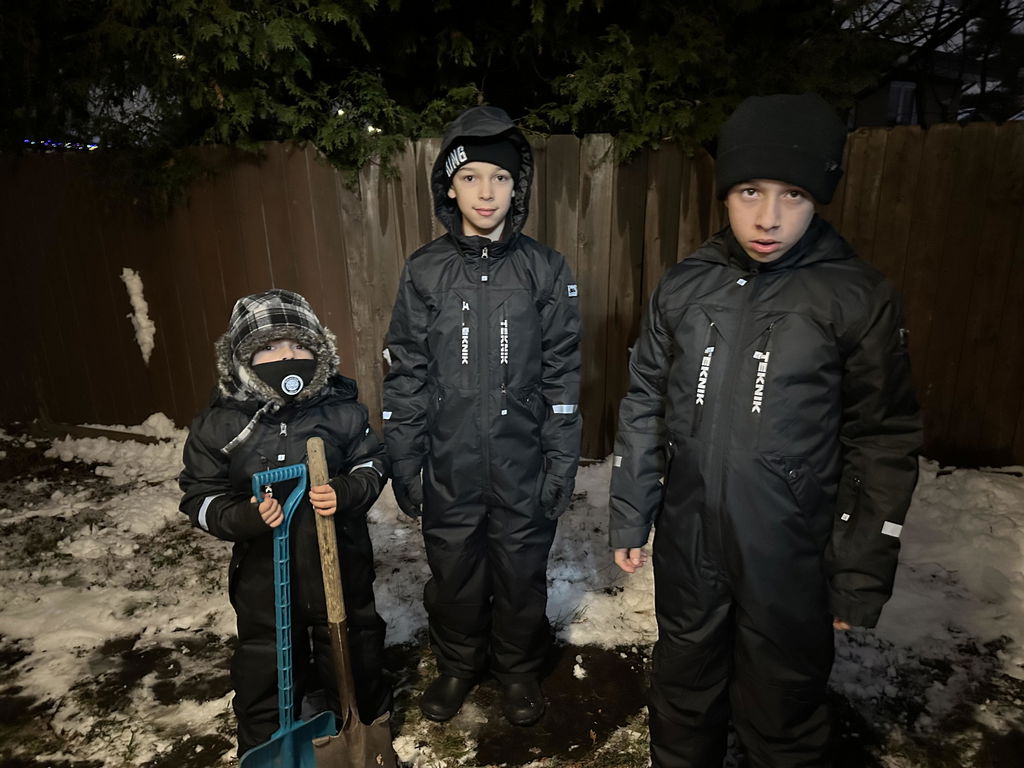
Quick answer: The right baby snowsuit or toddler snowsuit depends on your child's stage more than the age on the tag. Pre-walkers need full coverage, fold-over or removable mitts and booties, and easy zipper access. Walking toddlers need ankle snow gaiters, tougher knees and seat, and a format that works for daycare dressing. Fit comes before features.
Babies and toddlers spend winter in very different ways. A four-month-old rides in a stroller or carrier and barely moves. A one-year-old crawls through snow and pulls up on everything in sight. A two-year-old marches to daycare, sits in slush and wants to work the zipper alone. One snowsuit can't do all three jobs equally well, so this guide sorts features by stage instead of by brand or price.
If you already know your child's stage, you can go straight to baby girl snowsuits, baby boy snowsuits or the full one-piece snowsuit collection. For deeper detail on sizing, warmth ratings or one-piece vs two-piece, this guide gives a short answer and links to our focused articles instead of repeating them.
How Do Baby and Toddler Snowsuit Needs Change by Stage?
Snowsuit needs shift at three points: when your baby starts moving on their own, when they start walking outdoors, and when daycare or preschool routines begin. The ages below are rough guides only. Go by what your child is actually doing, not by the birthday.
| Stage | Typical winter day | Prioritize | Watch for |
|---|---|---|---|
| Pre-walker (about 0–9 months) | Stroller, carrier, short walks | Full coverage, fold-over or removable mitts and booties, long zipper | Extra bulk, hands lost in long sleeves |
| Crawler and new walker (about 9–18 months) | Crawling in snow, first steps, lots of time on the ground | Stirrups and gaiters that stay over boots, a seat and knees that handle wet snow | Attached booties that won't fit over real winter boots |
| Toddler (about 18 months–3 years) | Daycare outdoor time, sledding, walking to the car | Ankle snow gaiters, reinforced knees and seat, cuffs that close over mittens | Closures a caregiver can't manage quickly |
| Preschooler (about 3–4 years) | Daily outdoor play, learning to dress alone | Easy zippers, two-piece options | Covered in our school snowsuit guide (linked below) |
What does a pre-walking baby need in a snowsuit?
A pre-walking baby needs warmth that doesn't depend on movement, because they aren't making heat by playing. The Canadian Paediatric Society puts it plainly: "Babies need extra care and bundling because they cannot generate body heat or tell you if they are cold the way an older child can."
That makes three features worth checking first:
- Hand and foot coverage. Fold-over cuffs or removable mitts and booties keep small hands and feet covered without separate mittens that a baby can pull off. Deux par Deux lists removable fleece-lined mittens and booties on its Baby Original one-piece puffy snowsuit, and sherpa-lined fold-over hand and foot openings on its baby two-piece sets.
- Zipper length and placement. A long zipper that opens most of the suit makes it easier to get a floppy baby in and out, and to check a diaper without undressing them completely. Look at product photos of the suit unzipped before you buy.
- A hood that stays out of the face. The hood should frame the face, not slide over the eyes when your baby turns their head. A removable faux-fur trim is easier to wash and can come off if it brushes your baby's cheeks.
Check the size range, too. Many baby snowsuits start at 6 or 12 months. The Baby Original runs from 6 months to 30 months/2T, and the Deux par Deux baby two-piece sets start at 12 months. For the first months, many families use a bunting bag instead. Our infant bunting vs one-piece snowsuit guide compares the two.
What changes when your baby starts crawling and pulling up?
Once your baby crawls, the knees, seat and lower legs spend most of their outdoor time pressed into snow. The priority moves from pure warmth to coverage that stays in place while they move.
Look for adjustable stirrups that run under the foot and ankle snow gaiters that close over boots. Deux par Deux lists both adjustable rubber stirrups and ankle snow gaiters on the Baby Original, and its baby two-piece bib snow pants pair rubber stirrups with ankle snow gaiters.
This is also when booties start to give way to real boots. The Canadian Paediatric Society recommends "warm, waterproof boots that are roomy enough for an extra pair of socks and to wiggle toes." Removable booties let one suit cover both phases: keep them on for stroller rides, then take them off once your baby stands and walks in boots.
What do walking toddlers need for daycare and snow play?
Walking toddlers need a snowsuit that holds up to sitting, kneeling and falling all day, and that a caregiver can put on fast. At this stage, durability and quick dressing matter as much as warmth.
- Reinforced wear zones. Deux par Deux lists 500-denier Cordura® at the knees, seat and hems on its PLAY one-piece, which starts at size 2.
- Cuffs that close over mittens. Elastic cuffs with Velcro® tabs help keep snow out where the mitten meets the sleeve.
- Ankle snow gaiters. An inner gaiter that sits over the boot stops snow from packing in when a toddler wades through drifts.
- Reflective details. Short winter days mean many daycare pickups happen near dark. Several Deux par Deux suits list reflective details or bands.
Two-piece suits with bib snow pants start to make sense here, especially once potty training begins. Our one-piece vs two-piece snowsuit guide walks through the trade-offs by age.

Which Snowsuit Features Matter Most for Babies and Toddlers?
The features that matter most are the ones that solve your child's daily problem: cold hands for a stroller baby, wet knees for a crawler, snow in the boots for a toddler. Use this table to match features to stages, then confirm each feature on the exact product page, because one brand can build two suits very differently.
| Feature | What it does | Most useful for |
|---|---|---|
| Fold-over cuffs or removable mitts | Covers hands without separate mittens | Pre-walkers |
| Removable booties | Covers feet in the stroller, comes off for boots | Pre-walkers to new walkers |
| Long front zipper | Easier dressing and diaper checks | Babies |
| Adjustable stirrups | Keep legs from riding up over boots | Crawlers and toddlers |
| Ankle snow gaiters | Close the leg opening over boots | New walkers and toddlers |
| Reinforced knees and seat | Handle kneeling, sitting and sliding | Toddlers |
| Elastic cuffs with Velcro® tabs | Close the sleeve over mittens | Toddlers |
| Removable faux-fur hood trim | Easier washing, can come off near the face | All stages |
| Included neckwarmer | Covers the neck without a scarf | All stages |
| Reflective details | Easier to see at dusk | Toddlers walking to and from daycare |
Why choose a neckwarmer instead of a scarf?
A neckwarmer covers the same area without loose ends. The Canadian Paediatric Society advises parents to "Use a neck warmer instead of a scarf, and mitten clips instead of a string to prevent choking." Several Deux par Deux baby and toddler suits include a neckwarmer in the set, including the Baby Original and the baby two-piece sets.
The same thinking applies to drawstrings. The Canadian Paediatric Society says that for younger children, parents should "remove drawstrings from clothing that could catch on climbing or play equipment." Health Canada's compliance projects have also checked children's upper outerwear against the drawstring criteria in ASTM F1816-18, including drawstrings at the hood and neck area in sizes 0 to 12. When you compare snowsuits, look for hoods that adjust with Velcro® or an inside tab rather than a hanging cord.
How should you read warmth and waterproof numbers for a baby?
Read temperature and waterproof numbers as a way to compare suits, not as a promise about how your child will feel. Deux par Deux rates the Baby Original to -30°C (-22°F) and its baby two-piece sets to -20°C (-4°F), and lists a 5,000 mm waterproof coating on both. Its PLAY one-piece lists a 10,000 mm coating. A higher waterproof number matters more for a toddler sitting in slush than for a baby under a stroller cover.
Wind changes the picture too. Environment and Climate Change Canada explains that "The weather outside feels colder when it is windy, and we call this the wind chill." For a full walk-through of ratings, insulation and breathability, see our snowsuit temperature ratings guide.
One-Piece or Two-Piece: Which Format Suits Each Stage?
For most pre-walkers, a one-piece is simpler: there is no gap at the waist and only one thing to put on. For walking toddlers, both formats work, and the choice usually comes down to daycare routines and potty training.
- Pre-walkers: a one-piece with fold-over or removable hand and foot covers.
- New walkers: a one-piece, or a baby two-piece whose bib snow pants keep the back covered when they bend over.
- Toddlers in potty training: a two-piece, so they can use the bathroom without taking everything off.
Browse two-piece snowsuits if bib pants fit your routine. The detailed comparison of warmth, layering and growth is in the one-piece vs two-piece guide linked above.
Why Does a Close Fit Matter More for Babies and New Walkers?
A snowsuit should fit your child now, over normal layers, with enough room to reach, crawl and squat. Buying a much bigger size for next year usually means sleeves that swallow mittens and a crotch that sags toward the knees. That's harder on crawlers and new walkers than on older kids, because loose fabric catches under their knees and feet.
On each suit linked in this guide, Deux par Deux notes that it fits generously and advises not to size up. Some suits add room in other ways: the PLAY one-piece lists sleeves that extend 4 cm (1.5") and a two-level button hem that adds up to 7.6 cm (3").
For measuring, size charts and between-size decisions, use our snowsuit sizing guide for babies, toddlers and big kids. Buying for someone else's child? The snowsuit gift sizing guide covers what to ask the parents first.
How Do Layers Change From a Stroller Baby to an Active Toddler?
At every stage, thin layers under the snowsuit work better than one thick sweater. The American Academy of Pediatrics (AAP) says "Several thin layers will keep them dry and warm," and adds that "The rule of thumb for older babies and young children is to dress them in one more layer of clothing than an adult would wear in the same conditions."
With active toddlers, overdressing is the more common mistake. The Canadian Paediatric Society notes, "If your child's feet and hands are warm, what they are wearing is usually good," and warns that a child who is dressed too warm "could sweat and feel colder when they stop playing."
A simple formula works for most days: a snug base layer, a light mid-layer when it's colder, then the snowsuit. Our what to wear under a baby snowsuit guide has layer-by-layer examples, and the kids' layering guide covers days when the weather changes.
How Do You Plan Snowsuits for Daycare?
Plan daycare snowsuits around three questions: how fast can a caregiver dress your child, what happens when the suit gets wet, and what can your child start doing alone?
How many snowsuits does a toddler need?
Most toddlers can get through winter with one main snowsuit, as long as it dries fully overnight. A second suit, or a second pair of snow pants, starts to pay off when your child goes outside twice a day, your winters bring lots of wet snow, or gear has to live in two places, such as daycare and a grandparent's house. If you rely on one suit, our recess-ready snowsuit guide includes tips for drying a snowsuit overnight.
What should go in a daycare winter bag?
- Spare mittens. The Canadian Paediatric Society recommends "mittens instead of gloves so that fingers can be bunched together for warmth." Toddlers soak and lose them quickly, so pack a second pair from kids' gloves and mittens.
- Dry socks and a spare base layer. The AAP advises making sure "children change out of any wet clothes right away."
- A hat and neckwarmer. The Canadian Paediatric Society advises children to "Wear a hat because a lot of body heat is lost through the head." Toques and neckwarmers are in winter accessories.
- Name labels. Put your child's name inside the snowsuit, mittens and boots. Daycare cubbies fill up with look-alike gear.
How can you help a toddler start dressing alone?
Practice at home in the same order every time: suit legs or snow pants, boots, then the top, hat and mittens last. Big zipper pulls, Velcro® cuffs and bib straps that clip are easier for small hands than snaps. Many two-year-olds still need help, but a toddler who can push their own arms into the sleeves saves caregivers time at every outdoor transition, and that matters when a whole room is getting dressed at once.

How Should You Dress a Baby for Stroller Walks and Car Rides?
How do you keep a baby warm on stroller walks?
On stroller walks, your baby sits still while you warm up by walking, so check on them more often than you think you need to. Feel their hands and feet, keep their ears covered and shorten the walk on windy days. Environment and Climate Change Canada says that at a wind chill of -28 to -39, "any exposed skin can freeze in 10 to 30 minutes." The Canadian Paediatric Society suggests considering keeping children indoors "whenever the temperature or the wind chill is reported to be -27°C (-16°F) or lower."
What should a baby wear for winter car rides?
Car rides call for a different setup than outdoor play. The AAP states that "bulky clothing, including winter coats and snowsuits, should not be worn underneath the harness of a car seat." Instead, dress your child in thin layers, buckle them in, then lay a coat or blanket over the buckled harness. Follow the manual for your specific car seat, and see our guide to snowsuits and car seats for the full routine.
What Are the Most Common Baby Snowsuit Buying Mistakes?
- Buying a suit with attached booties for a child who already walks. Booties don't fit over winter boots. Look for removable booties, or open legs with stirrups and gaiters.
- Sizing a pre-walker up by a full year. Hands disappear in the sleeves and the suit bunches at the hips in the stroller.
- Choosing by temperature rating alone. A suit rated for deep cold does nothing for wet knees or snow packed into boots.
- Adding a scarf instead of a neckwarmer. The Canadian Paediatric Society recommends a neckwarmer, as quoted above.
- Skipping the zipper check. A short zipper makes dressing and diaper checks much harder, especially in a cold entryway.
- Forgetting the drying plan. One suit for daily daycare needs a reliable way to dry overnight.
- Buying the suit before the boots. Check gaiters and stirrups with the boots your child will actually wear.
More fixes for fit, overheating and drafts are in our common snowsuit mistakes guide.
Which Jenni Kidz Snowsuits Fit Each Stage?
These Deux par Deux styles line up with the stages above. All details come from the product pages, so check the current sizes on each page before you order.
Which snowsuit suits pre-walkers and new walkers?
The Deux par Deux Baby Original One Piece Puffy Snowsuit in black comes in sizes 6 months to 30 months/2T. Deux par Deux lists removable fleece-lined mittens and booties, a fleece-lined hood and body, a removable faux-fur hood trim, adjustable rubber stirrups, ankle snow gaiters, reflective details and an included neckwarmer, with a brand rating of -30°C (-22°F).
Which snowsuits suit walking babies and young toddlers?
Deux par Deux's baby two-piece sets pair a coat with bib snow pants in sizes 12 months to 36 months/3T. The Baby Two Piece Snowsuit in Blue Printed Teddy Bears and the Baby Two Piece Snowsuit in Rose Leopard Print both list sherpa-lined fold-over hand and foot openings, bib pants with adjustable straps, rubber stirrups, ankle snow gaiters, a sherpa neckwarmer and a brand rating of -20°C (-4°F).
Which snowsuits suit toddlers in size 2 and up?
Once your toddler wears a size 2, the kids' lines open up. The Kids One Piece PLAY Snowsuit in Gray and Blue Dinosaur Print lists a 10,000 mm waterproof coating, a -30°C (-22°F) rating, 500-denier Cordura® on the knees, seat and hems, ankle snow guards and sleeves that extend 4 cm (1.5"). For a two-piece snow suit, the Two Piece DISCOVER Snowsuit in Turquoise Blue With Navy Pants pairs a jacket with fleece-lined bib snow pants and lists reflective details, ankle snow gaiters and a -30°C (-22°F) rating in sizes 2 to 8.
To compare more styles, browse all kids' snowsuits, the Deux par Deux collection, or our kids snowsuit brands comparison. For a closer look at one brand's lines, read the Deux par Deux snowsuit guide.
This article is general information, not medical advice. Cold-weather guidance from health organizations is general; watch your own child closely and contact your pediatrician or family doctor about any concern, including skin that stays numb, pale or blistered after time in the cold.
Frequently Asked Questions
What should I look for in a snowsuit for a baby who isn't walking yet?
Look for full coverage, fold-over cuffs or removable mitts and booties, a long zipper for easy dressing and diaper checks, and a hood that stays out of the face. Pre-walkers don't make much heat by moving, so check their hands and feet often.
Does a toddler need different snowsuit features than a baby?
Yes. Walking toddlers need ankle snow gaiters that close over boots, reinforced knees and seat, and cuffs that close over mittens. Babies who don't walk yet get more from built-in hand and foot coverage and easy zipper access.
How many snowsuits does a toddler need for daycare?
One main snowsuit is usually enough if it dries fully overnight. A second suit or extra snow pants helps when your child goes outside twice a day, your winters are wet, or gear has to stay in two different places.
Are attached booties or open legs better for a toddler snowsuit?
Once a child walks outdoors, open legs with stirrups and ankle snow gaiters work better, because they fit over real winter boots. Removable booties give you both options: keep them on in the stroller and take them off when boots go on.
How can I tell if my baby is warm enough in a snowsuit?
Check hands and feet. The Canadian Paediatric Society says that if a child's feet and hands are warm, what they are wearing is usually good. If your child is sweating, they may be dressed too warmly. The AAP notes that frostbitten skin may turn white or pale gray, so bring your baby inside and call your doctor if you see that.
Should a baby snowsuit have a drawstring hood?
It's better to skip hood and neck drawstrings on young children's outerwear. The Canadian Paediatric Society advises removing drawstrings that could catch on play equipment and using a neck warmer instead of a scarf. Look for hoods that adjust with Velcro® or an inside tab.
When should my child move from baby snowsuits to kids' sizes?
Move up when your child fits the brand's size 2 or outgrows the baby range. The Deux par Deux baby styles at Jenni Kidz run up to 30 months/2T or 36 months/3T, while its PLAY and DISCOVER kids' lines start at size 2. Compare the measurements on each size chart before switching.
Bottom Line
Choose a baby or toddler snowsuit by stage. Pre-walkers need coverage that doesn't depend on movement: fold-over or removable mitts and booties, a long zipper and a hood that stays out of the face. Walking toddlers need gaiters that work with boots, tougher knees and seat, and cuffs that close over mittens. Dress in thin layers underneath, skip scarves and drawstrings, and size for this winter rather than next.
Sources
- American Academy of Pediatrics, HealthyChildren.org: Cold Weather Safety for Children: Preventing Frostbite & Hypothermia (last updated January 2023)
- American Academy of Pediatrics, HealthyChildren.org: Playing Outside in Winter: Tips to Keep Kids Warm & Safe (last updated January 2026)
- American Academy of Pediatrics, HealthyChildren.org: Winter Car Seat Safety Tips: Keeping Kids Safe & Warm (last updated February 2025)
- Canadian Paediatric Society, Caring for Kids: Winter safety: Advice for parents and kids (last updated February 2023)
- Environment and Climate Change Canada: Wind chill and the Wind Chill Index (modified December 2025)
- Health Canada: Archived Consumer Product Enforcement Summary Report: Drawstrings on Children's Upper Outerwear (2019–2020) (modified May 2025)